Buying guide
Pre-65 Trials Buyer's Guide: Which Classic British Trials Bike Should You Buy?
What pre-65 trials actually means, how the Scottish Pre-65 and club classes work, and how the BSA C15, Tiger Cub, Greeves, Ariel, AMC, Enfield and other classic British trials bikes compare on history, prices, parts and what to check.
Pre-65 trials is the oldest corner of classic trials still run on a big scale in the UK, and demand is strong. Entries for the 2027 Scottish Pre-65 Two Day Trial had passed 280 for 200 places five days before the closing date. The catch is that the bikes are now 60 to 70 years old, the rules vary from club to club, and a "pre-65" bike in a modern frame can cost twice as much as an original. This guide explains what pre-65 means, how the classes work, what each popular bike is like, what they sell for, and what to check before you buy.
What does "pre-65" mean?
In simple terms, a pre-65 trials bike is a machine of a type that was built before 1965. In practice it is mostly British four-strokes and Villiers-engined two-strokes from the late 1940s to the mid-1960s: BSA, Triumph, Ariel, AJS, Matchless, Norton, Royal Enfield, Velocette, Greeves, James, Francis-Barnett and DOT.
Why 1965? Trials Guru's history of the Scottish Pre-65 explains that the original organisers drew the line at the 1964 Scottish Six Days Trial (SSDT), the last year a big four-stroke won it. Bob Adamson, the first trial secretary, used the 1964 SSDT entry list as his guide: if a type of machine was there, it was eligible. That logic still shapes the whole scene. The idea is that the bike should look and work like something a rider could have entered in 1964.
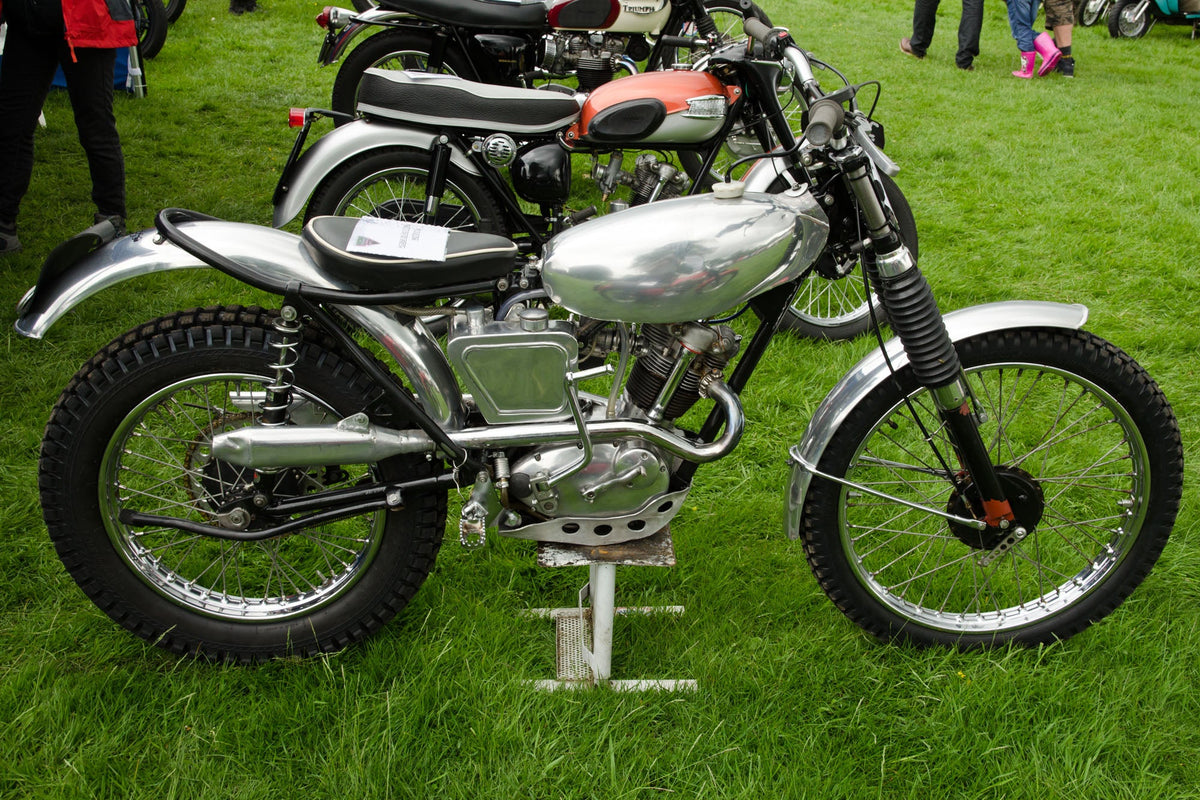
Very few of these bikes stayed standard. Works riders lightened them in period, and owners have been improving them ever since. Today you'll find three broad types:
- Originals: factory trials models, or road models converted in period, with their original frame and most original parts.
- Period-style specials: genuine old engines and parts, often in a modified or replacement frame, built to look like a 1960s bike.
- New-build replicas: new frames made to an old pattern from modern tubing, with new forks, wheels and engine internals. These are the fastest bikes in the class and the most argued about.
If you're new to trials, the basics are the same as in modern trials. You ride through a marked section without stopping or putting a foot down. An observer scores you: a clean is no penalty, a dab (one foot down) costs one mark, and so on up to five marks for a failure. Lowest total wins.
The Scottish Pre-65 Two Day Trial
Every pre-65 conversation ends up here. The first Scottish Pre-65 ran on Tuesday 8 May 1984 in the Mamore hills above Kinlochleven. According to Trials Guru, it began partly as a way of moving spectators away from busy SSDT sections at Achlain. It is promoted by the Edinburgh & District Motor Club, the same club that runs the SSDT, through a separate committee. It has run over two days since 1997.
The roll of winners tells you which bikes matter. Sammy Miller won the first on an Ariel, Dave Thorpe won repeatedly on a Triumph from 1987, and Gary Macdonald became the first Scot to win, on BSA and Triumph machines. Trials Guru lists Ariel wins in 2024 and 2025. In May 2026, TMX reported that Will Brockbank won on a 500 Ariel after a clean sheet over 60 sections. First-timer Tom Sagar was also clean on a 350 Triumph, and the tie-break went to the larger machine. The trophy was shared.
Dates and entry for 2027. The organisers' website lists the 2027 trial for 30 April and 1 May 2027. Entries are made online and closed at 11.45pm on Thursday 26 November 2026, with a ballot a few days later. Places are not first come, first served. On 21 November 2026 the site showed 280 entries for 200 places. The entry form asks for photos of the machine, and the organisers warn that unclear photos can lead to rejection.
Eligibility. The Scottish is known for being stricter than most club events. A 2011 TMX column summed up the principle: the machine's outline must stay true to the original, and foreign parts such as Japanese carburettors and modern forks are out. An eligibility sub-committee examines bikes, and since 2019 there has been an award for the best performance on an original machine. Rules change, so always read the current regulations and guidance before you build or buy for this event.
Classes: how pre-65 trials are split
There is no single national pre-65 rulebook. Each club, centre or championship writes its own, usually based on the event's supplementary regulations. Classes you'll commonly see include:
- Two-strokes: Greeves, James, Francis-Barnett, DOT and BSA Bantam, mostly 197 cc to 250 cc Villiers or BSA engines.
- Small four-strokes: Tiger Cub, BSA C15 and other lightweights, usually up to about 250 cc or 350 cc depending on the club.
- Big four-strokes: 350 cc and 500 cc singles from Ariel, AMC, BSA, Norton, Royal Enfield and Velocette.
- Rigid: bikes with no rear suspension, such as early AMC, Norton 500T and pre-swinging-arm Ariels. Some clubs run this as its own class, with easier lines.
- "Lightweight" or "original": some clubs separate small-capacity bikes, or unmodified bikes, from the specials.
For the Scottish, a 2018 ballot note from the Edinburgh club, quoted on the BSA Otter site, described roughly 50 places per capacity class. We couldn't confirm that still applies. At club level, routes are usually graded by difficulty, so a newcomer can ride an easier line. Always check the class rules before you buy. A bike that is fine for your local VMCC section might not be eligible for the Scottish.
Specials vs originals: the big debate
This is the argument that never ends in pre-65, and you need to understand it before you buy.
On one side are the purists. The BSA Otter enthusiast website argues that modern "copy" frames aren't really copies: they use lighter tubing and often have moved swinging-arm pivots and longer swinging arms. Its author blames expensive new-build machines for falling entries in UK classic trials. The 2011 TMX column made a similar point: a modern frame can look like a 1965 original but weigh far less, and modern damping inside old fork legs is almost impossible to police.
On the other side is reality. Original frames are scarce, bent or long gone, and replacement frames keep old engines in use.
The names you'll see most often:
- Faber frames: made in Cornwall, Faber Frames has built Otter-pattern replica frames since 2000. Its website lists basic frame kits for the BSA C15/B40 and Triumph Cub at £895 (no VAT, subject to confirmation) at the time of writing. It says its frames have been accepted as eligible for the Scottish Pre-65, and describes a Mk4 "A" Triumph Cub frame, released in October 2023, as Scottish compliant. Check the exact model with the organisers.
- Cheney: Eric Cheney was famous for scrambles frames, including Gold Star and C15-based specials in the 1960s, and Cheney Racing still makes frame kits for BSA unit singles. These are motocross-derived frames. One old club rules sheet listed Cheney among acceptable specials and then excluded Cheney frames from a pre-60 class in the same document. Treat any Cheney-framed trials bike as a question to put to the organiser, not an answer.
- Other new frames: Progressive Classic Products lists a Mick Mills frame for BSA unit singles from £975 at the time of writing.
Our advice: decide which events you want to ride first. For local club trials, a well-built special is often more enjoyable. For the Scottish, or if you care about history and resale, an original with a dating certificate is the safer bet.
The main pre-65 trials bikes compared
| Spec | BSA C15T | Triumph Tiger Cub (TR20) | Greeves Scottish | Ariel HT5 |
|---|---|---|---|---|
| Engine | 249 cc OHV four-stroke unit single | 199 cc OHV four-stroke unit single (63 × 64 mm) | 246 cc Villiers two-stroke single | 499 cc OHV four-stroke single (Red Hunter based) |
| Production | C15 range 1958–1967 | Cub range 1954–1968 | About eight years; TES from 1962 | Mid-1950s to 1959 (sources differ on start) |
| Period highlight | Arthur Lampkin, 1963 SSDT (factory 250 BSA) | Roy Peplow, 1959 SSDT, first small-capacity winner | Don Smith, 1964 European Trials Champion (TES) | Sammy Miller, 1962 and 1964 SSDT (GOV 132) |
| Weight | Not reliably published for the trials model | Not reliably published for the trials model | Not reliably published | About 290–300 lb, period claims |
| Recent UK auction results | £1,725–£2,484 (2024–2025) | £2,850 for a restored TR20 awaiting assembly (2025) | £1,610–£2,185 (2024–2025) | £3,265–£6,382 (2024–2026) |
| New replica frame | Yes (Faber, others) | Yes (Faber Mk4 "A") | Not common | Ariel-pattern specials exist |
| Dating help | BSA Owners Club | Triumph clubs (TOMCC, Cub club) | Greeves Riders Association | Ariel owners' club or VMCC |
The bikes, one by one
BSA C15T and B40
History. The C15 was a mild 249 cc commuter launched in September 1958, BSA's first four-stroke with the engine and gearbox in one unit. The trials C15T followed, with a higher-clearance frame, wider gear ratios, a 20-inch front wheel on UK bikes, a high-level exhaust and a softer camshaft. Classic Dirt Bike notes a lighter all-welded frame arrived in 1963. The 343 cc B40 was built for civilian use from 1961 to 1967 and later in large numbers for the British Army.
The works record is strong. Arthur Lampkin won the 1963 SSDT on a factory 250 BSA, and his brother Alan won in 1966, the last four-stroke SSDT win until 2007. Jeff Smith is the other big BSA name. He won the 1955 SSDT on a 500 Gold Star, then took 500 cc world motocross titles in 1964 and 1965 on C15-derived works bikes.
Character. The C15 is the default pre-65 bike. A 2024 Trials Central reply summed it up: heavier than a Tiger Cub but more powerful, and easy to maintain. That makes it a good choice for bigger riders.
Weak points. Wikipedia and Classic Dirt Bike agree on the list. The original engine used bushes where a competition engine would use roller bearings, the big end has a reputation for weakness, and the energy-transfer ignition divides opinion. Oil leaks, gearbox wear and valve-gear problems are common on tired engines. The contact-breaker points moved from behind the cylinder to the crankcase during production, which matters when you're buying parts.
Prices. Originals are still affordable. At Anglia Car Auctions in November 2024, a 1959 C15 trials bike owned since 1984 and used in pre-65 Scottish trials, with 12-volt electronic ignition and a V5, sold for £2,484 including premium. At H&H in October 2025, a c.1962 C15 trials bike with no paperwork sold for £1,840 including premium, and in July 2025 a 1961 C15T made £1,725. Competition specials cost more: a Faber-framed pre-65 C15 was advertised by a dealer at £4,995 at the time of writing. Expect a well-sorted special with modern internals to cost more again.
Parts. The best supported of all the pre-65 bikes. Engine, gearbox, frame and cycle parts are widely reproduced. Browse BSA C15 and B40 trials parts.
Triumph Tiger Cub (T20 and TR20 Trials Cub)
History. The Cub is a 199 cc OHV single built from 1954 to 1968. The TR20 Trials Cub had a high-level exhaust, a wide-ratio gearbox and different suspension. Works riders Roy Peplow and John Giles made it famous, and Peplow's 1959 SSDT win was the first by a small-capacity bike. The late Super Cub used a frame based on the BSA Bantam, which is why you'll hear "Bantam Cub".
Character. Light, slim and nimble, with a strong Scottish Pre-65 record. Competition Cubs are usually bored out to 230, 250 or even 270 cc. The downside is set-up: a 2024 Trials Central thread called it "a pain to set up". It suits lighter riders who enjoy tinkering.
Weak points. Wikipedia lists the main ones. The timing-side main bearing was a plain bush that could wear fast, the low top tube left the headstock poorly supported, and the primary chain had no tensioner. Ignition points sat in a distributor-type unit behind the cylinder until 1963, then moved to the end of the camshaft.
Prices. The spread is wide. A restored 1963 TR20 awaiting assembly sold for £2,850 at a Car & Classic online auction in April 2025. At the other end, a 270 cc pre-65 Cub was listed on eBay at £8,995, and a dealer advertised a Faber-framed 250 cc Cub at £5,800. Those are asking prices, not sale prices.
Parts. Good, with a big specialist network for engines and frames. See Tiger Cub trials parts.
Greeves (TES and TFS Scottish)
History. Bert Greeves founded the company in 1951, building Invacar invalid carriages for the government, with motorcycles as a sideline from 1953. Greeves bikes are instantly recognisable. The early frames used a cast aluminium-alloy beam as the front downtube, with rubber-in-torsion leading-link forks. The Scottish trials models used Villiers two-stroke engines. A 1963 Cycle World test described a 32A bottom end with a heavier flywheel for low-speed pulling. The TE, introduced in 1962, had a square-finned alloy barrel, and Don Smith won the 1964 European Trials Championship on a TES. The later 24TFS used the Villiers 34A.
Character. Simple, cheap to buy and easy to run. The leading-link forks feel different from telescopics. The limitation is the gentle Villiers engine, which can't match the later Spanish two-strokes.
Eligibility watch-out. A 24TFS built in 1965 or later may or may not be allowed, depending on how your club words its rules. The 1969 SSDT-winning Anglian is not pre-65 at all. Check the model and frame number.
Prices. Some of the best value in pre-65. At H&H in March 2024, an authentically restored c.1961 Scottish sold for £1,610 and a 1963 Scottish for £2,185, both including premium. A 1963 24TES made £1,610 at Iconic Auctioneers in July 2025.
Parts. The Greeves Riders Association helps track down and remake parts, and Villiers spares are widely available. See Greeves trials parts and Villiers engine parts.
James, Francis-Barnett and DOT (Villiers two-strokes)
History. AMC (the AJS and Matchless group) bought James in 1951 and later ran it alongside Francis-Barnett. Classic Dirt Bike's buying guide explains that Francis-Barnett's Falcon Trials 83, later developed into the Trials 85, had one of the best trials chassis of its day, with Norton Roadholder forks. It was let down when AMC fitted its own heavier, wider 250 engine. Mick Ransom still finished third in the 1963 SSDT on a works bike. James's Commando used a 197 cc Villiers, and Mick Andrews won the Scottish Pre-65 twice on a James. DOT bikes are rarer, but they are on most pre-65 eligibility lists.
Character. Light, cheap and easy to run. In a 2024 Trials Central thread, one rider suggested a Villiers-based James or Francis-Barnett for anyone wanting a pre-65 two-stroke.
What to look for. The Villiers-engined versions are the ones to buy. Classic Dirt Bike warns that the 19-inch rear wheel on some Francis-Barnetts makes trials tyres harder to find.
Prices. We couldn't find enough recent UK sale results to give a fair range, so compare adverts carefully. See James, Francis-Barnett and DOT parts.
Royal Enfield Bullet and Crusader trials
History. The 350 trials Bullet, launched in 1948, was one of the first production trials bikes with swinging-arm rear suspension. Johnny Brittain made it famous, winning the SSDT in 1952 and again in 1957 on HNP 331. Neil Gaunt won the Scottish Pre-65 on a Royal Enfield in 2004. The 250 Crusader-based trials bikes are a lighter, less common option.
Character. A big, torquey single with a proper rear suspension, which makes it a good choice for heavier riders and slippery going.
Prices. At H&H in October 2024, a 1957 Bullet trials replica, built into a 1959 frame to works replica specification, sold for £3,450 including premium. A c.1956 G2 Bullet trials bike sold for £1,840 at Iconic Auctioneers in July 2024. See Royal Enfield trials parts.
AJS 16C and 18C, Matchless G3C and G3LC
History. AMC's heavyweight singles dominated the SSDT in the early post-war years. Hugh Viney won the event four times on AJS machines, and Gordon Jackson won four more, including 1961 with just one mark lost. Artie Ratcliffe won twice on Matchless machines. Stig Karlsson won the Scottish Pre-65 on a Matchless in 2000.
Character. Heavier than the lightweights, but strong and simple. The 350s are the popular choice, and early bikes suit the rigid class.
Prices. A 1955 Matchless G3LC trials bike sold for £3,565 including premium at H&H in March 2025. A mostly original 1961 Matchless G3C made £3,583 at Iconic Auctioneers in April 2024. A 1957 AJS 16MC trials bike made a £2,956 hammer price at the Bristol Classic Motorcycle Show sale in February 2025. Progressive Classic Products lists new AMC rigid and springer trials frames at £795 at the time of writing. See AJS and Matchless trials parts.
Ariel HT3 and HT5
History. The HT3 (350) and HT5 (500) were trials versions of the Red Hunter, built from the mid-1950s to 1959. Sources disagree on the exact start date. Contemporary reports put the HT5 at around 290 to 300 lb, about 80 lb lighter than the standard road singles. Production was small. One forum post cites a figure of just under 460 HT5s, which we couldn't verify.
The legend is GOV 132. Sammy Miller worked in Ariel's competition shop and lightened his HT5 a great deal over the years. He won the SSDT on it in 1962 and 1964, before leaving Ariel at the end of 1964 for Bultaco. Classic Dirt Bike reports that GOV 132 is on display in the Sammy Miller Motorcycle Museum in New Milton, Hampshire, which has around 500 motorcycles. His similar second bike, 786 GON, is with an owner in Italy. Miller then won the first Scottish Pre-65 on an Ariel in 1984.
Character. Big and torquey. A well-built 500 Ariel is the bike to beat at the Scottish, with wins in 2024, 2025 and 2026, but it takes skill and strength in tight sections.
Prices. The most expensive of the common pre-65 bikes. A 1957 HT5 sold for £6,382 including premium at H&H in March 2026. A 1958 HT5 made £4,830 at Bonhams' Stafford sale in April 2026, and another 1958 bike made £3,265 at Iconic Auctioneers in July 2024. Competition Ariels built by known names cost more. See Ariel trials parts.
Norton 500T
History. Norton built the 500T from 1949 to 1954, combining the ES2's 490 cc OHV engine with a shortened, lightened rigid frame based on the 16H. The result weighed just under 300 lb. One source says 851 were built, which we couldn't confirm. Norton spent little on development, and the only notable late change was a bigger front brake for 1954.
Character and prices. A big, torquey rigid-class bike. UK results are thin: a 1950 500T project sold for £3,450 at Bonhams Stafford in April 2023, according to classic.com. See Norton 500T parts.
Velocette MAC and MSS
Velocette never had a big works trials programme like BSA or AMC, but the 350 MAC, built until 1960, makes a good trials engine. Trials rider Bill Swallow told Classic Bike Hub that its touring cams suit the job. Velocettes still appear at the Scottish: TMX's 2019 preview listed Richard Allen on a 350. It's a bike for Velo enthusiasts rather than first-timers, and we couldn't find enough recent trials-specific sales to give a reliable price range. See Velocette trials parts.
The rigid class
Rigid bikes have no rear suspension, which was normal before swinging arms spread in the mid-1950s. Many clubs run a rigid class with its own awards. Candidates include early AJS and Matchless singles, the Norton 500T, rigid BSA Bantams and pre-swinging-arm Ariels, and new rigid AMC and Bantam frames are available. Rigids are harder work in rough sections but often ride easier lines. Browse the BSA Bantam trials range if you're tempted by a lightweight rigid.
What to check before you buy
- Frame and engine numbers. Take photos and rubbings. Check them against the owners' club records before you pay. A mismatched or missing frame number affects both eligibility and registration. See frames.
- Frame type. Is it original, a period special or a new replica like a Faber? Ask the seller for the maker and mark, and ask your target event whether it is accepted.
- Paperwork. A V5C in the seller's name is worth a lot. Without one, budget for a dating certificate and a DVLA application.
- Engine bottom end. Listen for knocks and check for play. C15 big ends and Cub timing-side bushes are known weak points. See engine parts.
- Carburettor. Amal Monobloc and Concentric carbs wear at the slide and body. Many events don't allow Japanese carbs. See fuel and carb parts.
- Ignition. Is it magneto, points, energy transfer or a modern electronic kit? Electronic ignition is common and often accepted, but check. See ignition and electrics.
- Gearbox and clutch. Check all the gears select cleanly and the clutch frees off. Hydraulic clutches caused controversy at the Scottish in 1996. See clutch parts.
- Oil leaks. Some weeping is normal. Heavy leaks from crankcase joints usually mean a rebuild.
- Forks and wheels. Check for bent stanchions, worn bushes, loose spokes and the rim sizes. Trials tyres in some sizes are hard to find. See suspension and wheels.
Paperwork: V5C and dating certificates
To ride road sections at the Scottish, the bike must be registered, taxed and insured. Most pre-65 bikes qualify for historic vehicle tax and MOT exemption, but must still be roadworthy. With no V5C, you'll need a dating certificate from the right owners' club. Examples at the time of writing:
- BSA Owners Club: £10 for members, £20 for non-members, with side-on photos of the complete machine and rubbings or photos of the numbers. The machine may need an inspection.
- VMCC: a standard dating certificate costs £45 on its form, or £70 where archive research is needed. VMCC says the process can take up to six weeks.
- Greeves Riders Association: inspects and dates complete machines. A frame number enquiry alone won't produce a DVLA-ready certificate.
- Triumph: the Triumph Owners MCC runs a dating service, and the Tiger Cub club holds factory records for Cubs.
One catch: VMCC warns that a bike built from a mixture of new and used parts, such as a replica frame with an old engine, may get a Q registration instead of an age-related number.
How to get started in pre-65 trials
Find a club. Most pre-65 trials in England and Wales are run by VMCC sections and classic-specific clubs. The VMCC says many of its geographical sections run off-road trials through the year, and membership lets you enter any of them. South Durham VMCC, for example, runs a seven-round pre-65 championship from February to May and September to November, with the best six scores counting, and offers day membership. The Midland Classic MCC runs pre-65 and twinshock trials. The AMCA publishes a list of classic trials clubs and handles licences through its online portal. Many ACU-permit club trials also include pre-65 classes. In Scotland, the LLMCC runs a Scottish Classic Championship.
Budget sensibly. Based on recent auction results, an original runner costs roughly £1,600 to £3,600 for a C15, Greeves, Bullet or AMC 350, and more for an Ariel. A sorted competition special can cost twice that. On top, budget for club membership or a licence, event entries, trials tyres, a dating certificate if needed, and spares. Owners on Trials Central say doing your own spannering is what keeps it affordable.
Start on the easy route. Ride a few club trials on the easiest line before you think about the Scottish.
C15 vs Tiger Cub vs Greeves: who each suits
Here's how the three most popular first pre-65 bikes compare for different riders. The further right the dot, the better the fit.
Who should buy what?
- First-time pre-65 riders: a BSA C15. Plenty of power, easy to fix and the best parts supply.
- Lighter riders who enjoy tinkering: a Tiger Cub. Light and agile, with a superb Scottish record, but it needs careful setting up.
- Two-stroke fans on a budget: a Greeves Scottish, James or Villiers-engined Francis-Barnett. Some of the cheapest ways into the class.
- Bigger, experienced riders: a 350 AJS or Matchless, Royal Enfield Bullet or Ariel HT. Torque and grip, but more weight to manage.
- Riders aiming to win the Scottish: a well-built 500 Ariel or a top Cub, and a big budget.
- History lovers: an original with a dating certificate. Look at the rigid class too.
The Trials Bike Classifieds verdict
For most riders getting into pre-65 trials in the UK, the BSA C15 is the right first bike. It's affordable, with originals selling for around £1,700 to £2,500 at recent UK auctions, it's easy to keep running, and parts are everywhere. The Tiger Cub is the better competition bike in skilled hands, and the Greeves is the bargain. Whatever you buy, decide first whether you want to ride club trials or the Scottish, because the specials-versus-originals question changes everything about what you should pay. Check the frame, the paperwork and the club rules before you check the paint.
Where to find a pre-65 trials bike in the UK
Many good pre-65 bikes change hands within the classic trials community, through clubs and forums. Auction houses such as H&H, Bonhams, Anglia and Iconic regularly offer trials bikes, often with limited history. Keep an eye on our bikes for sale pages, including BSA C15, Tiger Cub, Greeves and Ariel listings.
Related reading
The first parts to fit
- Trials tyres. Fresh, period-pattern rubber at the right pressure transforms grip. See tyres.
- Sump guard. Protects the engine cases on rocks and steps. See sump guards.
- Chain and sprockets. Cheap to replace and the easiest way to change the gearing. See chain and sprockets.
- Cables and levers. A light, smooth clutch makes old bikes far easier to ride. See throttles and cables and levers.
- Ignition. A reliable electronic kit, if your class allows it. See ignition and electrics.
- Air filter. Old engines hate grit. See air filters.
- Workshop manual. Essential for any 60-year-old bike. See books and DVDs.
Browse everything for the era in our pre-65 trials section. Always check each listing's fitment against your model and year before you buy.
Frequently asked questions
What does pre-65 mean in motorcycle trials?
It means a machine of a type built before 1965, mostly British four-strokes and Villiers-engined two-strokes. The Scottish Pre-65 based its cut-off on the 1964 SSDT, the last year a big four-stroke won it. Each club sets its own detailed eligibility rules.
When is the 2027 Scottish Pre-65 Two Day Trial?
The organisers list it for 30 April and 1 May 2027, based at Kinlochleven and run by the Edinburgh & District Motor Club. Entries closed at 11.45pm on 26 November 2026, with places allocated by ballot.
How do you get an entry for the Scottish Pre-65?
You enter online during the entry window and submit photos of your machine. There are 200 places and the event is oversubscribed, so a ballot decides who gets in. Over 280 entries had been received for 2027 by 21 November 2026.
What is the best pre-65 trials bike for a beginner?
For most riders, a BSA C15. It is more powerful than a Tiger Cub, easy to maintain and has the best parts supply. Lighter riders might prefer a Cub, and two-stroke fans a Greeves or Villiers-engined James.
How much does a pre-65 trials bike cost in the UK?
Recent UK auction results for original bikes run from about £1,600 for a Greeves Scottish to around £6,400 for an Ariel HT5. BSA C15 trials bikes have sold for roughly £1,700 to £2,500. Well-built competition specials usually cost considerably more.
Are replica frames allowed in pre-65 trials?
It depends on the event. Faber says its frames have been accepted for the Scottish Pre-65, but rules vary between clubs and change over time. Always check with the organiser before buying a bike with a replica frame.
How do I register a pre-65 trials bike with no V5C?
Get a dating certificate from the relevant owners' club, such as the BSA Owners Club, Greeves Riders Association or VMCC, then apply to the DVLA. A bike built from a mix of new and used parts may be given a Q registration instead of an age-related number.
Where can I ride pre-65 trials in the UK?
Many VMCC sections and classic clubs run pre-65 trials, such as South Durham VMCC's monthly championship and the Midland Classic MCC's pre-65 and twinshock trials. The AMCA publishes a list of classic trials clubs, and many ACU-permit club trials include pre-65 classes.
More reviews & comparisons
- Trials Bike Maintenance Guide: After-Trial Routine, Service Intervals and Winter Storage for UK ClubmenA practical maintenance routine for UK trials riders: how to wash without wrecking bearings, what to check before eve...
- Two-Stroke vs Four-Stroke Trials Bike: Montesa 4RT vs Beta Sincro, Sherco and TRRS for UK RidersWith Beta's Evo 4T on its last batch, Montesa is almost the only four-stroke left. We compare two-stroke and four-str...
- How to Start Trials Riding in the UK: Clubs, Licences, Kit, Costs and Your First Bike (2026/27)The complete beginner's route into observed trials in Britain: how scoring works, finding an ACU or AMCA club, 2026 l...
- Best youth petrol trials bike 2027: Beta Evo 80 Junior vs Senior, TRRS 80 and the step to 125Moving your child up from an electric bike? We compare every new and used petrol youth trials bike for UK riders, fro...