Buying guide
How to Start Trials Riding in the UK: Clubs, Licences, Kit, Costs and Your First Bike (2026/27)
The complete beginner's route into observed trials in Britain: how scoring works, finding an ACU or AMCA club, 2026 licence fees, trials schools, choosing a first bike, the kit the rules require, road registration and what your first trial day looks like.
Observed trials is the cheapest, safest and most sociable way to compete on a motorcycle in Britain, and right now it is easier to start than it has been for years. The ACU has folded personal accident insurance into a £35 club registration, it is running beginner-friendly Kickstart events with four routes down to "absolute beginner", and the used market is full of good Beta Evos as riders move to the new Sincro. But nobody hands you a manual. This guide does: scoring, clubs, 2026 licence costs, training, your first bike, the kit the rules demand, road registration and what your first Sunday will look like.
What trials actually is
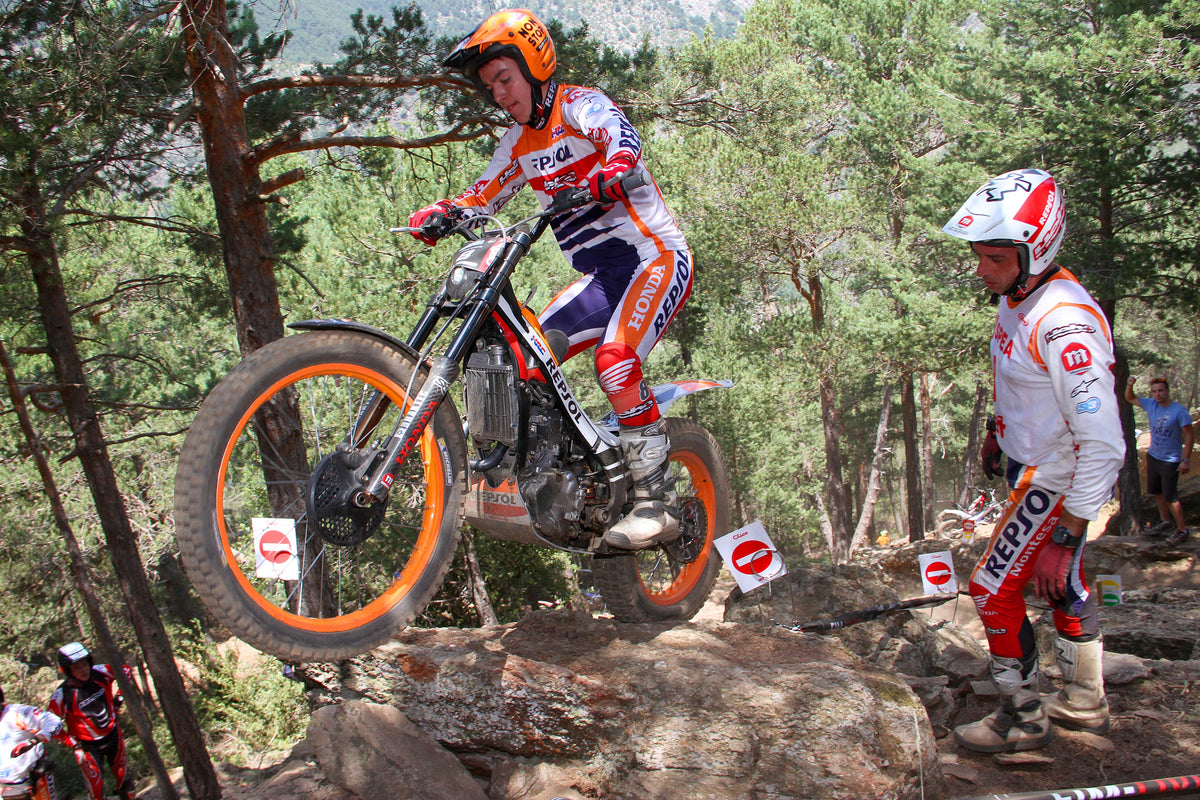
A trial is a test of balance and throttle control, not speed. The organiser marks out a series of short, tricky pieces of ground called sections: a rocky stream bed, a muddy bank, a tight turn between trees, a step up a boulder. Each section is bounded by tapes or marker flags, with a "Section Begins" card at the start and "Section Ends" at the exit. You ride the sections one at a time, usually over several laps, and an official called the observer stands at each one and scores you.
The aim is to get through without putting a foot down. Ride it feet-up and you score a clean, which is zero marks. Touch the ground with a foot (a dab) and you lose marks. At the end of the day the rider with the fewest marks in each class wins. Speeds are walking pace and most falls are gentle topples, which is why a 60-year-old with good balance can beat a fit 25-year-old.
Trials is very British: the Scottish Six Days dates from 1909 (see our Scottish Six Days Trial guide), and clubs run one-day trials on farms, quarries and moorland all year, winter included. According to the ACU, there are many hundreds of affiliated clubs running trials, and most riders are within an hour of an event, usually on a Sunday.
How the scoring works
Learn this before your first event, because it shapes how you ride. Under the ACU's Standing Regulations, a normal section where stopping is allowed is marked like this:
| What happens in the section | Marks lost |
|---|---|
| Clean: no foot down, no failure | 0 |
| Footing once (one dab) | 1 |
| Footing twice | 2 |
| Footing more than twice | 3 |
| Failure, or asking for a five rather than attempt it | 5 |
| Missing a section, or not getting your card marked | 10 |
"Footing" means more than a boot on the ground. Any part of you or the bike touching the ground counts, except the tyres and the sump guard. Leaning on a tree or wall counts too. A failure (a "five") is given if the bike goes backwards, you stop with a foot down and take a hand off the bars, the engine stalls while you are footing, you get off, you cross a boundary tape or ride the wrong side of a marker, you knock down a marker that has to be put back, you cross your own wheel tracks, or anyone helps you. Footing outside the section's side limits is just a dab, not a five.
For newcomers, that means three things. Paddling through with three dabs beats stalling for a five. A 10 for missing a section is double a failure, so never skip one. And you must genuinely attempt 75% of the sections to count as a finisher. Ties usually go to the rider with the most cleans.
Some events are run "non-stop", where simply stopping in a section counts as a failure. The ACU's own beginner page still describes this older rule. Your event's regulations will say which applies, so check before you ride.
Finding a club: ACU, AMCA and youth clubs
Two organisations run most UK trials, and you will probably ride under both at some point.
The ACU (Auto-Cycle Union)
The ACU is the national governing body, organised into regional centres (Yorkshire, Midland, Southern, Northern and others), each with its clubs, fixtures and championship. Use the "Find a Club Near You" directory on the ACU website, then your centre's fixture list and each event's supplementary regulations (the SRs: venue, start time, classes, routes and entry fee). A small "closed to club" trial is the friendliest start.
The AMCA (Amateur Motor Cycle Association)
The AMCA is the other big body, with its own rulebook and its own clubs. It publishes separate lists of modern and classic trials clubs on its "Start Trials" page. AMCA trials take riders from age six on petrol bikes, with 4 to 6-year-olds on electric bikes of up to 2 bhp. AMCA and ACU scoring follow the same basic idea, but always check the event regulations, as the AMCA rulebook governs AMCA events.
Youth clubs and classes
Many clubs run youth classes alongside adults, and some centres have dedicated youth trials and championships. Under the ACU rules a child can ride an electric bike from four and a petrol bike from six. Youth classes (A to E) are set by birth year, each with limits on engine size and wheel size, and a minder (an adult helper, who must be at least 18) can walk with younger riders. Before you buy a child's bike, check their class. Our best youth petrol trials bike guide sets out the 2026 age bands, and our Triumph TXP review covers electric bikes for younger children. Kids' parts and bikes are in kids' trials.
Classes and routes for adults
Adult classes are not set by engine size. You choose a route by ability. The ACU says there is no national standard: clubs run their own mix of novice, clubman, intermediate, expert, over-40, sidecar, twinshock and pre-65 classes, often with up to four routes through each section. The Standing Regulations recommend marking the hardest route blue and red, the second yellow and the third white, but organisers can choose their own colours. The ACU's 2026 Kickstart events used red for the hardest route down to yellow for "absolute beginners". So the first question to ask at signing-on is: which colour is my route?
The best way to choose a club is to watch one first. Experienced riders on Trials Central give older beginners the same advice: visit a local event and talk to riders afterwards. Clubs are also where good used bikes change hands.
Licences and registration: what it costs in 2026
You can't ride an ACU trial without an ACU registration or licence. The Standing Regulations require every rider to hold a current ACU (or Scottish ACU) Trials Registration card or a competition licence. For 2026 the ACU set these fees:
- Club trial registration: £35 for the season. This covers club-level trials and is all most beginners need.
- National trial registration: £50, new for 2026, for riders who want to enter national-level trials.
- Competition licence: £98, which covers other disciplines too.
The big change for 2026 is that personal accident insurance is now built into both registrations and the licence. It pays a daily hospital benefit after 72 hours, up to £2,000 per stay, and ACU-permitted competitions carry £40 million of public liability cover. None of this applies at non-ACU events. Several centres also publish lower youth rates and a one-event option, so if you only want to try a single trial, ask your centre.
The AMCA is cheaper. Its 2026 licence form lists a trials licence at £25, valid until 31 January 2027. You apply through a club, and the licence isn't issued until the club authorises it. Card payments carry a small processing fee. The AMCA site also mentions a one-day licence, but it does not publish the price on its start page, so ask the club.
On top of this, most clubs ask you to be a member before you can enter. Membership fees vary by club and are usually modest. Then there's the entry fee for each event. Youth entries we found for 2026 ran from free to £20, with £10 to £15 most common. A Sorra classic championship round in 2026 cost £30. Adult club entries vary, so check each event's regulations.
Trials schools and training days
One day with a good coach will save you a season of bad habits and bent levers. If you have never ridden off-road, it's the single best first step, and you can do it before you own a bike or any kit.
The best-known dedicated centre is Inch Perfect Trials, near Clitheroe in Lancashire's Forest of Bowland. Its courses are graded from Level 0 (absolute beginner) to Level 5 (advanced), for ages 12 and up. Listings checked in November 2026 show a full beginner day at £150 on a weekday with bike hire, £175 at weekends, or £115 with your own trials bike. An "absolute beginners" day that includes bike hire, riding gear, food and a damage waiver is listed at £199 on weekdays and £219 at weekends. There are also two-hour adult tasters for around £99 to £109, and half days. A typical full day runs from 9.30am to 2.30pm with a lunch break. Prices differ between booking sites, so check the centre directly before you pay.
The ACU is also putting money into beginners. Its Kickstart programme ran women's weekends in 2026, at Keypitts Farm in Devon (February and March) and Scarborough (May). Saturday was coaching from ACU-registered coaches, focused on confidence and core skills. Sunday was a relaxed trial with four routes, the easiest for absolute beginners, all on small-wheel bikes as well as full-size ones. The Scarborough trial was 10 sections over three laps with a four-and-a-half-hour time limit. Bike hire wasn't available, though the ACU said it hoped to offer it in future. Watch the ACU news page for 2027 dates.
Many clubs also run practice days and can point you to local coaches.
Choosing your first bike
Owners on Trials Central agree on one thing above all: buy something in good condition from a well-supported make, and don't buy too much bike. UK prices below were checked in November 2026.
A used modern bike (the default)
A modern monoshock two-stroke from the last ten to fifteen years is the bike most clubs, coaches and mechanics will steer you to. They are light, they turn tightly and the brakes work. The Beta Evo is the obvious buy. Trade asking prices ran from £2,195 for a 2013 Evo 300 to £2,999 for a 2022 and £3,295 for a road-registered 2020 bike, and Evo values are being pushed down by the arrival of the Sincro. Used Montesa 4RT 260s were advertised from about £2,000 to £3,400 for 2014 to 2022 bikes, and four-stroke smoothness is very kind to novices. GasGas TXT and Sherco ST bikes are often cheaper than equivalent Betas. Our used trials bike buyer's guide goes model by model, and the GasGas TXT buying guide covers that brand's uncertain future.
On capacity, owner advice is consistent. A 200 or 250 is the sweet spot for most adult beginners. A 125 is fine for lighter riders and teaches good habits. A 300 can be too lively for a part-timer, and even softer-tuned 300s catch some novices out. Browse Beta Evo, Montesa 4RT and Sherco ST listings, or all trials bikes for sale.
A new modern bike
New full-size bikes cost from £6,399 (TRRS One R) to £8,799 on the road (Montesa Cota 4RT 301RR) at the time of writing. The new Beta Sincro starts at £6,445 for the 125, and the Montesa 260R is £6,999. The Sincro 200 or 250, or the 260R, make sensible first bikes if you want a warranty. But a new bike loses value fast, and you will drop it a lot in year one, so a tidy used bike plus money for training and kit is usually the smarter start. Our best trials bike 2027 group test compares every current model.
A twinshock
Twinshocks (bikes with two rear shocks, mostly built before the mid-1980s) have their own classes and a very relaxed, friendly scene. A Yamaha TY250 twinshock was typically advertised at about £1,650 to £1,995 this autumn, and recent UK auction results for good twinshocks ran from under £1,000 to over £4,000. They're simple, hold their value and twinshock routes are set to suit them. But they're heavier, with less suspension and weaker brakes, so owners nearly all say buy a modern bike if you want to climb the routes. For relaxed classic trials, a TY175, TY250 or Fantic 200 makes a great first bike. See our best twinshock trials bike guide, the air-cooled monoshock guide for the cheap middle ground, and the pre-65 buyer's guide if British four-strokes are your thing.
An electric bike
Electric Motion's Epure has proved electric trials bikes work, right up to world level. For a beginner there's no clutch to stall, no premix, and they're quiet enough to practise without upsetting the neighbours. The drawbacks are price and uncertainty. We could not confirm a sterling RRP for the 2027 Epure Race or Factor-e, a used 2025 Factor-e in Devon was listed at £5,700, and replacement batteries and controllers are expensive. They also need charging, and EM's minimum charging temperature is 0°C, which matters at a frosty winter trial. Our electric trials bikes guide covers the costs in detail.
First-bike options compared
Prices are UK asking prices, auction results or dealer list prices at the time of writing (November 2026), drawn from our buying guides. Treat them as a starting point.
| Option | Used modern (e.g. Beta Evo 250) | New modern (e.g. Beta Sincro, Montesa 260R) | Twinshock (e.g. Yamaha TY250) | Electric (Electric Motion Epure) |
|---|---|---|---|---|
| Typical UK price | About £2,200 to £3,300 for a good 2013 to 2022 Evo | £6,399 to £8,799 new (£6,445 Sincro 125; £6,999 Montesa 260R) | About £1,650 to £1,995 asking for a TY250; auctions from under £1,000 | Used 2025 Factor-e listed at £5,700; 2027 UK RRP not confirmed |
| Ease for a novice | Good on a 200 or 250 | Very good, with a dealer to help | Harder: heavier, weaker brakes | Very good: no clutch to stall |
| Classes it suits | Any adult route, novice to expert | Any adult route | Twinshock and classic classes | Any adult route (ACU power limits apply to youths) |
| Running costs | Low; parts everywhere | Low, plus servicing to keep the warranty | Low if sorted; some parts scarce | Low day to day; batteries and electronics are expensive |
| Resale | Steady, but softening as Sincros arrive | Biggest first-year loss | Holds value well | Uncertain |
The kit you need: what the ACU rules say
The Standing Regulations (TSR.12, Clothing) set the minimum. For adults:
- A correctly fitted motorcycle helmet, worn at all times while riding at the event. Cycle helmets are not allowed. Helmet cameras and body cameras are banned unless the camera is built into the helmet by the maker; a camera on the bike is fine. The ACU's gold helmet sticker rule, which took effect in January 2026, covers every ACU discipline except trials, so you don't need one. Buy ECE 22.06 anyway. See best trials helmets and our helmets page.
- Boots of roughly knee length, in leather, rubber or plastic. Proper trials boots have flexible soles for feel on the pegs and grip when you dab. See best trials boots and boots.
- Clothing covering your legs and body. Covered arms are recommended, and so are gloves.
Youth riders must also cover their arms and wear gloves that cover hands and fingers. The ACU's June 2026 Technical Control update says that at minimum, officials will check at the start line that each rider has a helmet on and that each youth rider is wearing a back protector. Adults aren't required to wear one, but many do. Our body armour page has options.
What you actually want to buy, in order:
- Helmet. An open-face trials helmet. ECE 22.06 models start under £50 (the Wulfsport Aspect was listed from £38.75) and a Hebo Zone 5 is around £100.
- Boots. The biggest spend. Proper trials boots cost about £200 to £340 in the UK, and youth boots from about £125. Don't ride in motocross boots if you can avoid it; they're too stiff to feel the pegs.
- Trials pants and jersey. Light, stretchy and hard-wearing. See trials pants and jerseys. Many riders start in any tough trousers and a long-sleeved top.
- Gloves. Thin trials gloves for feel. Hebo's Trial Team gloves were listed around £26 to £29. See gloves.
- A waterproof jacket. Winter club trials are wet. See jackets.
The bike has rules too. Examiners check for ball-ended levers, folding footrests, a self-closing throttle, a chain guard and proper trials tyres, which must meet tight ACU limits on width and tread (see best trials tyres). Bikes must not exceed 100 dBA at two metres, and random sound tests can lead to disqualification. A lanyard cut-out (a kill switch clipped to the rider) is compulsory on youth bikes and recommended on adult ones.
Transport and road registration
Getting the bike to the event
Most riders use a van, a small trailer or a tow-bar rack. Take a stand, a basic tool kit, spare fuel and premix, and dry clothes.
Do you need a road-registered bike?
For most club trials, no. They are held on private land, and the bike needs no number plate, tax, MOT or road insurance. Most trials bikes in the UK were never registered, so most are sold with no V5C (the log book) at all.
You need a road-registered bike if an event uses public roads between groups of sections. That's common on longer trials and essential for events like the Scottish Six Days. The Standing Regulations put the responsibility on you: if the event uses the highway, your bike must meet every legal requirement, your tyres must carry the proper road-legal markings, and you need motor insurance that meets the Road Traffic Act for the event, either by extending your own policy or through the event road-section scheme the regulations describe. A road-registered bike must also be taxed, and have an MOT once it is three years old.
Many new modern bikes can be registered by the dealer when you buy them. One Beta dealer quoted about £112 including tax at the time of writing. To register a used bike that has never been on the road, you send DVLA a V55/5 form. GOV.UK lists a £55 new registration fee "if you have to pay it", and £25 for a replacement V5C. Forum advice from owners who have done it is mixed on lights and horns for the MOT, so talk to your MOT tester before you book.
If you're buying a registered bike, check that the frame and engine numbers match the V5C and that the seller's name and address are on it.
Your first trial: what the day looks like
Here's how a typical Sunday club trial runs, in order.
- Enter. Many clubs take entries online in advance (the ACU uses the Sport80 system), and some still take entries on the day. Read the SRs for start time, classes and route colours.
- Arrive early. Give yourself an hour. Park where the marshals tell you, unload, and get changed.
- Sign on. Show your registration card, sign the declaration and pay. You'll be given a riding number or bib and, where routes differ, something to show which route you're on. Ask which colour flags you follow.
- Machine examination. Under the 2026 rules the minimum check happens at the start line: helmet on, and back protector on for youths. Clubs can choose to run a full check of the bike, and the Clerk of the Course can inspect any bike at any time. Either way, your bike should be in sound condition with good brakes, ball-ended levers and a working kill switch.
- Get your punch card. Many clubs give each rider a card that the observer punches or marks at each section; others use an electronic chip or an observer's sheet. Look after it. Losing or defacing it can lead to disqualification.
- Walk the sections. You are allowed to walk a section before you ride it with no penalty, and you should. Look for the line, the grip and where your route's flags are. Experienced riders will happily tell you how they plan to ride it.
- Ride. Wait for the observer to call you in. Entering before you're called costs five marks. Ride your line, and if it goes wrong, take your dabs rather than a five. When you exit, show your card and get it marked. If you disagree with a score, say so politely and report it to the secretary of the meeting straight away; arguing with the observer gets you nowhere.
- Lap. Most trials run several laps of the same sections, so your second and third laps will be better. Trials also have a time limit, so keep moving.
- Finish. Return your card at the finish, even if you retire early, and sign off if asked. Results go up later that day or on the club website.
Observers are volunteers, often standing in the rain for hours. Thank them as you leave each section.
What a season costs
Here's what a first season looks like, using 2026 fees and November 2026 prices. The bike is the big variable.
| Item | Typical UK cost | Notes |
|---|---|---|
| ACU club trials registration | £35 a season | £50 national, £98 competition licence; insurance included (2026) |
| AMCA trials licence | £25 a season | Applied through a club (2026 form) |
| Club membership | Varies by club | Usually needed to enter; ask the club |
| Entry fees | Free to £20 a youth event; around £30 for a classic championship round | 2026 examples; adult club fees are in each event's regulations |
| Training day | £115 (own bike) to £150 to £219 (with hire) | Inch Perfect listings, November 2026 |
| Helmet | About £40 to £195 | ECE 22.06 recommended |
| Boots | About £200 to £340 (youth from about £125) | The biggest kit cost |
| Gloves, pants, jersey | Gloves from about £26; pants and jersey vary | Any tough clothing will do to start |
| Rear tyre | About £82 to £165 | Front about £54 to £72; a keen rider gets through a rear a season |
| Used modern bike | About £2,200 to £3,300 | Beta Evo, Montesa 4RT, Sherco ST |
| Road registration (if needed) | £55 DVLA fee if payable; about £112 via one dealer | Plus insurance and, after three years, an MOT |
Add van fuel, premix, gearbox oil, filters, pads, chains and the odd snapped lever. The good news: a well-kept used trials bike can often be sold for close to what you paid.
The scale: which first bike suits you
These are editorial judgements based on owner reports, used prices, parts support and the ACU rules, not a timed test. The further right the dot, the better the fit.
How to improve
The riders who improve fastest tend to do the same few things.
- Practise little and often. Half an hour of figure-of-eights, slow turns and feet-up balance on a flat patch of private land (with the landowner's permission) beats one long day a month. Many clubs have practice grounds or run practice days.
- Get coaching at each stage. Graded schools such as Inch Perfect run courses from absolute beginner to advanced, so you can go back as you improve.
- Walk sections properly. Look for grip, not just the line. Watch where better riders put their wheels.
- Observe for a day. Watching dozens of riders try one section shows you what works.
- Move up a route when you're cleaning most of yours. Staying on an easy route too long teaches you nothing new.
- Keep the bike right. A slipping clutch, worn tyre or dragging brake costs marks. Fresh oil, a good tyre at the right low pressure and well-adjusted controls make a real difference.
Who should start where?
- Complete beginner, never ridden off-road: book a trials school day with bike hire first. Then buy a used 200 or 250 modern bike.
- Road rider or returning rider: watch a club trial, get a £35 ACU registration and a tidy used Beta Evo or Montesa 260, and enter the novice route.
- Classic fan who likes spanners: a Yamaha TY or Fantic twinshock, ridden in twinshock classes.
- Parent of a young child: start with a small electric bike and a local youth club, and check the ACU or AMCA age bands before you buy anything.
- Rider with neighbours or no practice ground: an electric bike, if the budget allows.
- Women new to the sport: look out for the ACU's Kickstart weekends, which combine coaching and a beginner-friendly trial.
The Trials Bike Classifieds verdict
Start with a day's training, not a bike. At £115 to £219, a trials school day tells you whether you love it before you spend thousands. Then buy a tidy used modern 200 or 250, ideally a Beta Evo or Montesa 4RT 260, for about £2,200 to £3,300. It suits every route from novice to expert, parts are everywhere and it will hold most of its value. Register with the ACU for £35, which now includes accident insurance, or the AMCA for £25, and join a local club. Spend properly on boots and a helmet, and enter the easiest route at a small closed-to-club trial. Twinshocks and electric bikes are great, but as a deliberate choice rather than a default.
Where to find your first bike and kit in the UK
Many first bikes come through clubs and word of mouth. Dealers offer warranties; private sales are cheaper but riskier. Browse trials bikes for sale, including Beta Evo, Beta Sincro, Montesa 4RT, GasGas TXT Pro and Yamaha TY twinshock listings, and the parts pages for modern trials, twinshock trials and kids' trials bikes.
Related reading
What to check before your first trial
- Levers and controls. Ball-ended levers are required, and bent ones are normal. Spares are in levers, and folding pegs in footpegs.
- Tyres. A worn rear costs grip and marks, and competition tyres must meet ACU limits; see tyres.
- Brakes. Check pad wear and that both brakes bite in the wet; see brakes.
- Clutch and oil. Fresh gearbox oil often cures a sticky clutch; see oils and clutch parts.
- Chain and sprockets. Adjust the chain and check the guard is fitted; see chain and sprockets.
- Kill switch and lanyard. Compulsory for youths, recommended for adults; see ignition and electrics.
- Sump guard. You'll land on it a lot. A sound sump guard protects the engine cases.
Frequently asked questions
How much does it cost to start motorcycle trials in the UK?
A sensible start is a used modern bike at about £2,200 to £3,300, boots at £200 to £340, a helmet from about £40 to £100, and an ACU club trials registration at £35 for 2026. Add club membership, entry fees and running costs such as tyres and oil.
Do I need a licence to ride a motorcycle trial?
You don't need a driving licence for a club trial on private land, but you do need a sporting registration. The ACU's 2026 club trials registration costs £35 and includes personal accident insurance; the AMCA's 2026 trials licence is £25 through a club.
How does scoring work in motorcycle trials?
An observer scores each section: 0 for a clean, 1 for one dab, 2 for two, 3 for more than two and 5 for a failure such as stalling while footing or crossing a tape. Missing a section costs 10. The lowest total wins.
What is the best first trials bike for an adult beginner?
For most adults a tidy used modern 200 or 250, such as a Beta Evo or Montesa 4RT 260, is the best first bike. It suits every route, parts are easy to find and it holds its value.
Does a trials bike need to be road registered?
Not for most club trials, which are on private land. If an event uses public roads, the bike must be registered with a V5C, taxed, insured for road use and have an MOT once it is three years old.
What kit do ACU rules require for trials?
A correctly fitted motorcycle helmet, boots of roughly knee length and clothing covering legs and body. Gloves and covered arms are recommended for adults and compulsory for youths, and youth riders are checked for a back protector under the 2026 rules.
How old do you have to be to ride trials?
Under ACU rules a child can ride an electric trials bike from age four and a petrol bike from six. Riders can compete as adults from 16.
Where can I learn to ride trials?
Trials schools such as Inch Perfect Trials in Lancashire run graded days from absolute beginner upwards, with bike and kit hire. The ACU's Kickstart events and many local clubs also offer coaching and practice days.
More reviews & comparisons
- Trials Bike Maintenance Guide: After-Trial Routine, Service Intervals and Winter Storage for UK ClubmenA practical maintenance routine for UK trials riders: how to wash without wrecking bearings, what to check before eve...
- Two-Stroke vs Four-Stroke Trials Bike: Montesa 4RT vs Beta Sincro, Sherco and TRRS for UK RidersWith Beta's Evo 4T on its last batch, Montesa is almost the only four-stroke left. We compare two-stroke and four-str...
- Best youth petrol trials bike 2027: Beta Evo 80 Junior vs Senior, TRRS 80 and the step to 125Moving your child up from an electric bike? We compare every new and used petrol youth trials bike for UK riders, fro...