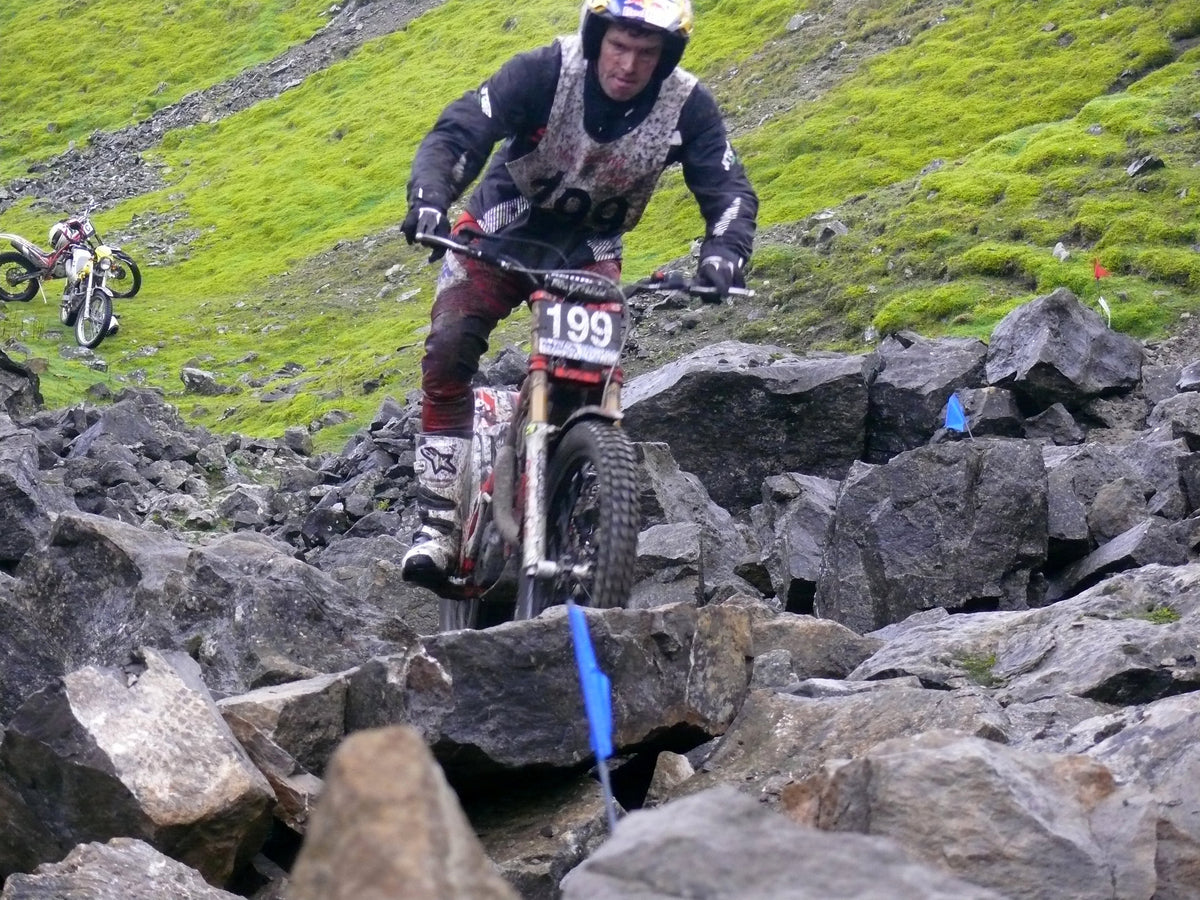
Buying guide
The Scottish Six Days Trial: Complete Guide for 2027 (Spectators and Would-Be Riders)
Everything UK riders and fans need to know about the SSDT: 117 years of history, the format and scoring, recent winners including Adam Raga's one-mark win in 2026, how the ballot works, bike preparation, parc ferme rules and where to watch in May 2027.
The Scottish Six Days Trial is the event every trials rider talks about and most never ride. It has run, with breaks only for war, foot and mouth and Covid, since 1909. In 2026 it produced one of its closest finishes ever: Adam Raga beat the Hemingway brothers by one mark and two marks after six days and 168 observed sections. Entries for 2027 closed on 16 November 2026, the ballot is being drawn now and successful riders hear in December. Whether you have just applied, plan to watch, or hope to ride it one day, this guide covers the history, format, rules, winners, bike preparation and how to watch it well.
What is the Scottish Six Days Trial?
The SSDT is a six-day reliability trial for solo motorcycles, run by the Edinburgh & District Motor Club from a base in Fort William in the West Highlands. Each day riders follow a long marked route over moorland, forestry tracks, rocky paths and public roads, and tackle groups of observed sections along the way. An observed section is a short, marked-out piece of hard ground where an official (the observer) scores you on whether you put a foot down. A "dab" is one foot touching the ground; a "clean" is getting through without any.
What makes the Scottish different from a club trial is the combination. The sections are hard, but the real test is doing them for six days in a row, on the same bike, with no outside help, against the clock, in Highland weather. The organisers describe up to 100 miles a day and around 30 sections a day. In 2026 the week covered more than 400 miles and 168 observed sections, according to the ACU. Days typically run six to eight hours, and riders start at one-minute intervals from 07:30.
Factory riders and world champions start alongside clubmen, services teams and relay teams. For most, getting to Saturday night is the achievement.
A short history: Edinburgh, Fort William and 117 years of the Scottish
The first Scottish trial ran in July 1909 as a five-day event devised by the Edinburgh Motor Cycle Club, starting and finishing in Edinburgh with a turn at John O'Groats. It became a six-day event the following year, and the Edinburgh & District Motor Club has run it since 1911, which is why its official centenary was celebrated in 2011, according to Trials Guru.
- Early years. A marking system with time penalties for machine faults was agreed by 1914, and an outright winner was first declared in 1932. That first winner was Bob MacGregor on a Rudge, who won again in 1935; he remains the last Scot to win.
- The move west. Fort William became the focus of the event before the war, but the start and finish stayed in Edinburgh for decades. Only in 1977 did the whole event move to Fort William, partly because Edinburgh accommodation was being taken up by another gathering that year. It has been based there ever since.
- Breaks. The trial was not run during the Second World War, in 2001 (foot and mouth disease), or in 2020 and 2021 (Covid-19).
The roll of honour tracks the history of the sport itself. Hugh Viney took the first hat-trick on an AJS (1947 to 1949). Roy Peplow's 1959 win on a 199 cc Triumph Tiger Cub was the first by a small-capacity machine. Gordon Jackson won in 1961 having lost a single mark all week, a dab on Grey Mare's Ridge. Sammy Miller's 1965 win on a Bultaco was the first for a two-stroke, and Alan "Sid" Lampkin's 1966 win on a BSA was the last four-stroke victory until James Dabill won on a Montesa 4RT in 2007. Bill Wilkinson's 1969 win was the last by a British rider on a British bike, and Finland's Yrjö Vesterinen became the first overseas winner in 1980.
Famous winners and records
One name dominates. Dougie Lampkin has won the Scottish 14 times: 1994 to 1996, 2008 and 2009, seven in a row from 2012 to 2018, then 2022 and 2023. The 2023 win, on a Vertigo, was reported by the ACU and the regional press as his record-extending fourteenth. He was still in the top ten in 2026, finishing seventh on 18 marks. Behind him the list of multiple winners reads like a who's who of British trials.
| Rider | SSDT wins | Winning years |
|---|---|---|
| Dougie Lampkin | 14 | 1994 to 1996, 2008, 2009, 2012 to 2018, 2022, 2023 |
| Sammy Miller | 5 | 1962, 1964, 1965, 1967, 1968 |
| Mick Andrews | 5 | 1970 to 1972, 1974, 1975 |
| Hugh Viney | 4 | 1947 to 1949, 1953 |
| Gordon Jackson | 4 | 1956, 1958, 1960, 1961 |
| Steve Saunders | 4 | 1988 to 1991 |
| Steve Colley | 4 | 1992, 1993, 1997, 2000 |
| Graham Jarvis | 4 | 1998, 1999, 2004, 2006 |
Recent winners
The last five events show how the trial has changed. Lampkin won the first two after Covid with very low scores. Then a new generation took over: Jack Price in 2024, Jack Peace in 2025 with a remarkable 4 marks lost, and Adam Raga in 2026. Scores below are marks lost over the whole week (lower is better) from the organisers' provisional results.
| Year | Winner (machine) | Marks lost | Second | Third |
|---|---|---|---|---|
| 2026 | Adam Raga (Sherco) | 10 | Harry Hemingway, 11 | George Hemingway, 12 |
| 2025 | Jack Peace (Sherco) | 4 | Adam Raga, 7 | George Hemingway, 12 |
| 2024 | Jack Price (Sherco) | 18 | Jack Peace, 21 | Harry Hemingway, 22 |
| 2023 | Dougie Lampkin (Vertigo) | 6 | Billy Green, 8 | Michael Brown, 10 |
| 2022 | Dougie Lampkin (Vertigo) | 8 | Michael Brown, 14 | James Dabill, 15 |
| 2020, 2021 | Not held (Covid-19) | |||
| 2019 | James Dabill (Beta) | See official results | ||
| 2015 to 2018 | Dougie Lampkin (Vertigo) | Four wins in a row | ||
2026 in detail. Raga, the two-time world champion, had finished second in 2025 and had never won the Scottish. He dropped no marks until day four, according to ACU Trial GB, then lost five at the final section at Fersit on the penultimate day, which let 18-year-old George Hemingway draw level going into Saturday. On the final morning both made mistakes in the first group at Lower Fassfern, where George stopped on a large rock step for a five. Harry Hemingway rode almost perfectly to slip between them. Raga became the first foreign winner since Joan Pons in 2003. TMX described him as one of the oldest winners in the event's history. Sherco also took the manufacturers' team award, Emma Bristow was best woman (50th overall), Jarand Gunvaldsen (TRRS) was best newcomer, and Holly Dixon became the youngest woman to ride the event and finished. Of 280 starters, 26 retired, mainly through fatigue and mechanical trouble.
The winning bikes are all mainstream trials machines: Sherco for the last three years, Vertigo and Beta before that. Our 2027 trials bike group test covers the current range.
How the scoring works
Each observed section is marked on the familiar scale, but the Scottish adds penalties that club riders rarely meet. These come from the 2024 Supplementary Regulations, the latest published set.
- Observation. One mark for one dab, two for two, three for more than two, five for a failure. A failure includes stopping (even balancing still or rolling backwards counts), dismounting, or a wheel crossing or knocking down a section marker. It is a "no stop" trial.
- Time. You lose a mark for every minute (or part of one) that you are late at the start or at a control. Arrive early at a time control and you lose marks too. More than 60 minutes over your allowed time in a day means automatic retirement.
- Asking for a five. In 2024, a rider who asked for a five rather than attempt a section scored ten, and repeat offenders could be excluded.
- Missed sections and rest stops. Missing a section or sub-section cost 50 marks. Skipping the compulsory 15-minute rest stop cost 15.
- Machine penalties. Failing to start and ride out of parc fermé within your minute costs five marks. Losing or breaking the stand costs five marks a day until it is repaired, as does a defaced number plate.
Ties are split under the ACU's standard tie-break rule; in 2026 Jack and Dan Peace both finished on 15 marks.
Classes and awards
There are no capacity classes as in a club trial, where you choose a route by ability. Everyone rides the same route and sections. Instead, awards go by finishing position: a Special First Class award to the first 50 finishers, a First Class award to the next 80, a Second Class award to the next 80, and a finisher's award to everyone else who gets to the end.
Alongside the overall trophy (the North British Rubber Company Trophy) there are trophies for the best newcomer, best Scot, best overseas rider, best services rider, best over-40, best woman, best under-21, and the Tiddler Trophy for the best rider under 19 on a petrol machine up to 200 cc. Team awards include club teams, services teams and the Orkney Islands Medal for official manufacturer teams.
Parc fermé and the route rules
Parc fermé is the secure area in the West End car park in Fort William where bikes are kept overnight. It is the heart of the event, and its rules shape everything about how riders prepare.
- Sealing. Before the start, examiners mark the engine and frame. You must ride the same machine all week; a missing seal you cannot explain means disqualification.
- Twenty minutes. Riders may enter parc fermé only 20 minutes before their start time. All work is done by the rider alone. No one else may help.
- No overnight repairs. Bikes go in "complete in every respect" at the end of the day. You cannot leave bolts loose for a quick fix in the morning, and covers and tarpaulins are banned, so bikes sit out in the Highland weather.
- No outside assistance on the route. No back-up rider, no van following you, and no help from other riders or anyone else. Spares you carry can be fitted during running time.
- Fuel. The club refuels every bike at its own fuel stops, and the cost is in the entry fee. Fuel can only be carried in an approved tank fixed to the bike.
- Road rules. Much of the route uses public roads and rights of way. Any rider stopped by the police or charged with a road traffic offence is disqualified, and a 15 mph limit applies on forestry ground.
- Legal and safe. The bike must be road legal, insured, taxed and (where needed) have an MOT. It must have a permanently fixed stand and a working lanyard kill switch, and helmet-mounted cameras are banned. Power washers are not allowed.
How entry works
The SSDT is heavily oversubscribed. The 2027 application form says around 500 applications are normally received for 288 places. The organisers' rider page gives a slightly different figure (270 places, 450 to 500 entries a year), so treat the exact number as approximate.
- Apply in October and November. Entries for 2027 opened on 18 October 2026 and closed at midnight on Monday 16 November 2026, through the online ballot application form on ssdt.org.
- Reserved places. Up to 50 riders are invited by the club, and a limited number of places go to manufacturer and sponsor entries. Importer and services entries need confirmation from the importer or service team manager.
- The ballot. Everyone else goes into a random ballot. Successful applicants are told in December.
- Relay teams. A number of places are set aside for relay teams, where two or three riders share one entry and ride different days. It is a realistic way to sample the event if you cannot commit to the full week.
Who can enter? Under the 2024 regulations riders had to be 17 by the end of April in the year of the event, and hold an ACU Trials Registration card or SACU licence. Riders from other countries need a national licence and start permission from their federation. You must attend a compulsory safety briefing on the Sunday before the trial and present your bike for sealing that morning.
If you missed 2027, the realistic plan is to watch in May, ride as many long club trials as you can over the summer, and apply when entries open around October 2027.
What it costs to ride
The organisers do not publish the entry fee on their public pages, and no current figure appears in the event reports we used. What they do say is that the fee covers your entry, food and lunch each day (a reduced lunch on Saturday) and the fuel the club puts in your bike. For context, Trialworld reported a fee of £400 for the 2011 event; it has risen since, and you should check the current figure on the entry paperwork.
The organisers warn that the Scottish is not cheap, and that everything else is extra. Budget for:
- Accommodation for at least a week in or near Fort William, plus travel there.
- Insurance. You need road traffic insurance that covers competition. In 2024 the club offered a top-up policy through its insurance broker for £40 if your own policy excludes it.
- Consumables. Experienced riders fit a new chain and sprockets, brake pads and tyres before the event, and many change the rear tyre midweek.
- Spares and kit. Inner tubes, a pump, levers, a spare tube for the front, waterproofs and a fresh pair of socks every day.
- Time. Six days of riding plus the Sunday sign-on and travel means most riders need well over a week away.
Bike preparation: what riders actually change
Most SSDT advice agrees on one thing: get the bike fully ready before you leave home and do not experiment in Fort William. John R Shirt, who had ridden 34 Scottish Six Days when Trial Magazine published his advice in 2024, recommends starting about six weeks out and asking your UK importer for their preparation checklist. Importers support their riders in the paddock for long days during the event.
Tyres and tubes
Shirt recommends a new front tyre with a thicker front inner tube, and a new rear (he suggests Michelin for grip, Dunlop for security on the rim), then a fresh rear after three days. Trialworld's centenary guide also suggests changing the rear on day three and running low pressures for grip. Tyres must be FIM or ACU approved trials tyres. See our guide to the best trials tyres.
Gearing
This is where advice splits. Some importer preparation guides have suggested gearing up for riders whose main aim is to finish, so the bike is calmer and more economical on long road sections. Shirt takes the opposite view: keep the gearing you know, because unfamiliar ratios will confuse you in the sections. Our view, siding with the long-time riders: if you are riding to finish, a small change is reasonable only if you have practised on it for weeks first.
Chain, brakes and bearings
Fit a new chain and sprockets before the event, along with new brake pads, fresh gearbox oil and a re-packed silencer. Service the forks and, on an older bike, the shock. Check and grease the linkage, and check wheel bearings and spokes.
Cooling, air filter and water
Moorland grass and mud clog radiators. Riders fit a front mudflap and radiator mesh, and clear the radiator after each moor crossing. Shirt notes that most trials bikes hold only about 300 ml of coolant, so stop and top up if it boils. A new, well-oiled air filter is standard, and some riders drill a small drain hole in the lowest point of the airbox.
Fuel
The club refuels you at set points, so a long-range tank is not needed for the route as such. Some riders still carry a small reserve. Shirt suggests about 500 ml in a metal bottle, since bad weather and deep going use more fuel. Remember the regulations: fuel must be carried in an approved tank fixed to the bike, so check that any reserve arrangement complies with the 2027 rules before you rely on it.
Lights, plate and stand
Because every bike is examined daily and must comply with the law on the road, lights and the rear number plate need to work all week. A bike that would break the Road Traffic Act can be excluded as unrideable. Check the wiring, protect connectors with dielectric grease, and make sure the stand is permanently fixed, not held up with a rubber strap.
Protection and what to carry
A sound sump guard matters more on rocky Highland going than at most club trials. In a small rucksack or bum bag, riders carry inner tubes, tyre levers, a puncture kit and pump, a split link and pliers, zip ties and tape, the tools to remove the plug, carb and air filter, cylinder head O-rings on older bikes, water and food.
The spectator's guide
Watching the SSDT is free, and you see world champions and clubmen on the same rocks, often within touching distance. A few rules matter, because the event depends on landowners' goodwill.
- Leave the trail bike at home. Spectators are not allowed to ride off-road on any part of the course, which is private land. Road bikes on public roads are fine.
- Buy the programme. Outline routes appear on ssdt.org in April. The official programme, sold in Fort William from late April and at parc fermé, has the full route maps, the best viewing points, approximate timings and the entry list. Proceeds go to charity.
- Park properly. The West End car park is closed to the public during the event. At sections, never park in passing places on single-track roads, keep fully off the road, and follow police directions. Arrive early or choose a less popular section.
- Stay off restricted ground. Not every section is open to spectators, and some need a long walk.
Where to watch
The route changes every year, so always check the programme. That said, some places appear again and again in past previews from TMX and Trials Guru:
- Parc fermé, any morning. Watch riders work on their bikes in their 20 minutes before the 07:30 start. It is the best place to see factory riders up close.
- Leanachan. A rocky riverbed close to Fort William, with plenty of parking and a viewing platform. Often a Monday favourite.
- Lagnaha. A popular group with a short walk from the village, and in past years tea and cake in the village hall.
- Kinlochleven and the Mamore Road. Historic ground: Callart, Lower Mamore and the climb to the Pipeline. The Pipeline needs a 20-minute-plus loose uphill walk but is a true SSDT landmark.
- Fersit. The boulder field where Raga took his costly five in 2026. Past previews put the walk across the fell at 40 to 50 minutes; worth it on a fine day.
- Friday's roadside groups. Friday has often been a long, mostly tarmac day, with sections such as Pipers Burn close to the road.
- Ben Nevis, Glen Nevis and Town Hall Brae. The Saturday finale. Most spectators head for the lower slopes of Ben Nevis or Glen Nevis, then the last section on Town Hall Brae ("Rocky Brae") in the centre of Fort William.
Getting there and where to stay
Fort William is the best base because every day starts and finishes there. It is reached by the A82 and by rail on the West Highland Line, including the overnight sleeper from London. Accommodation fills early in the first week of May, so book as soon as the dates are known. The town's tourist information centre and the Visit Fort William site list options, and Kinlochleven, Glencoe and Spean Bridge are all within reach of the route.
Weather and midges
Expect everything. Shirt's advice to riders applies to spectators too: the weather changes quickly, and staying dry matters most. In 2026 the week was mostly kind, with sunshine and light drizzle. Bring waterproofs, warm layers and walking boots. Midges are less of a worry in early May than in high summer. VisitScotland puts the season at May to October with the peak in mid-summer, worst in the west Highlands on calm, damp mornings and evenings. Pack a midge repellent anyway, and check for ticks after walking through long grass or moorland.
The Pre'65 Scottish and other Scottish trials
The week before the SSDT has its own classic event. The Edinburgh & District Motor Club Pre'65 Scottish Two-Day Trial is based in Kinlochleven and has run since 1984. It is for pre-1965 machines (think BSA C15s, Triumph Tiger Cubs and twins, Ariels and Villiers-engined two-strokes), with an eligibility team checking each bike from photos you send with your entry.
- 2027 dates: 30 April and 1 May 2027.
- Entry: 200 places, decided by ballot. Entries close at 11.45pm on Thursday 26 November 2026, and the organisers had received 280 entries by 21 November, so a ballot is certain. The entry list is due on Friday 27 November.
- Format: 60 sections over two days, 30 a day, in past years.
- 2026 winner: Will Brockbank on a 500 Ariel, clean over both days, beating Tom Sagar (400 Triumph) on the tie-break because his bike was the larger capacity, as reported by the ACU Northern Centre.
Other multi-day Scottish trials are popular stepping stones. Brockbank won the Leven Valley two-day trial (also at Kinlochleven) and the Alba Two Day Trial at Achallader before his Pre'65 win. For bikes and parts, see our pre-65 trials collection and our pre-65 trials buyer's guide.
SSDT vs Scott Trial vs Pre'65 Scottish
Britain's three best-known long-distance trials are very different events. The Scott Trial is a single day in October in Swaledale, North Yorkshire, scored on time and observation added together, so speed between sections matters as much as feet-up riding.
| Event | Scottish Six Days Trial | Scott Trial | Pre'65 Scottish |
|---|---|---|---|
| First held | 1909 | 1914 | 1984 |
| Base | Fort William | Swaledale, around Reeth | Kinlochleven |
| Length | Six days; 168 sections and 400+ miles in 2026 | One day; about 80 miles, 76 sections | Two days; 60 sections |
| Scoring | Observation, plus time penalties | Time and observation added together | Observation |
| Machines | Solo trials bikes, road legal | Trials bikes, road legal | Eligible pre-1965 machines only |
| Places | Up to 288, by ballot after reserved places | 199 started in 2026 | 200, by ballot |
| 2026 winner | Adam Raga (Sherco), 10 marks | George Hemingway (Beta), 28 (7 time + 21 obs) | Will Brockbank (Ariel), 0 |
| 2026 finishers | 254 of 280 starters | 93 of 199 starters | Not published in the reports we used |
| 2027 dates | 3 to 8 May | October, date to be confirmed | 30 April and 1 May |
The Scott is arguably the tougher single day: fewer than half the 2026 starters were classed as finishers. The SSDT is the bigger commitment and the bigger spectacle. The Pre'65 Scottish is the most relaxed to watch and, for classic owners, the most realistic Highland ride.
Is the SSDT for you?
Ask yourself honestly where you sit:
- Yes, apply, if you ride intermediate-level club trials comfortably, have finished long-distance events such as a two-day trial, can do your own roadside repairs, and can take more than a week off.
- Try a relay team first if you are fit and capable but unsure about six days in a row.
- Watch first if you have never seen it. A week as a spectator teaches you more about the sections, the pace and parc fermé than any guide.
- Go for the Pre'65 Scottish if you own or want a classic. Many riders do both events in the same fortnight, one as a rider and one as a spectator.
- Build up first if you are a novice. Long national trials and two-day events are the right preparation, not a ballot entry.
The Trials Bike Classifieds verdict
The Scottish Six Days Trial is the one event every UK trials rider should see, and the one most serious clubmen should try to ride once. It is not the hardest set of sections in the calendar, but nothing else combines expert-level sections with six days of distance, weather, self-reliance and strict parc fermé rules. The 2026 result, decided by one mark after six days, shows it is as compelling at the front as ever. Lower down the field, preparation decides most results: a fresh, familiar bike, the right spares and steady pacing count for more than raw section skill. If you cannot get an entry, the Pre'65 Scottish and the other Highland two-day trials are excellent consolation prizes, and watching from Leanachan or the Pipeline is free.
Finding a bike for the Scottish
You do not need a factory bike. The last decade's winners rode Sherco, Vertigo and Beta machines, and the rest of the field covers every current make plus older bikes in good order. What matters is a road-registered bike with a V5C, in sound condition, that you know well. Keep an eye on trials bikes for sale, including Sherco ST, Vertigo and Beta Sincro listings, and browse all modern trials parts.
Related reading
The first parts to fit before the SSDT
- Tyres and tubes. A new front with a heavy-duty tube, a new rear, and a spare rear for midweek; see tyres.
- Chain and sprockets. Fit new before the event and carry a split link; see chain and sprockets.
- Brake pads. Six days of wet grit will wear out tired pads; see brakes.
- Air filter. Start with a new, well-oiled filter and carry a spare; see air filters.
- Cooling. Check hoses and the radiator, and fit mesh protection; see cooling.
- Sump guard and protection. Highland rock is unforgiving; see sump guards and protection.
- Spare levers and tools. Gear and rear brake levers, plus a compact roadside kit; see levers and tools.
- Kit for the weather. A light waterproof jacket, good gloves, goggles and broken-in boots; see jackets, gloves, goggles and boots.
Frequently asked questions
When is the 2027 Scottish Six Days Trial?
The 2027 SSDT runs from Monday 3 May to Saturday 8 May 2027, starting and finishing in Fort William each day. Sign-on and machine sealing take place on the Sunday before.
How do you get an entry for the SSDT?
You apply through the ballot form on ssdt.org, which opened on 18 October 2026 and closed on 16 November 2026 for the 2027 event. After reserved club, manufacturer and sponsor places, the rest are drawn at random, and successful applicants are told in December. Around 500 people apply for up to 288 places.
Who has won the Scottish Six Days Trial the most times?
Dougie Lampkin, with 14 wins between 1994 and 2023. Sammy Miller and Mick Andrews have five each.
Who won the 2026 SSDT?
Adam Raga (Sherco) won with 10 marks lost, one ahead of Harry Hemingway and two ahead of George Hemingway. He was the first foreign winner since Joan Pons in 2003.
Is it free to watch the Scottish Six Days Trial?
Yes, spectating is free. Buy the official programme in Fort William for route maps and viewing tips, park responsibly, and do not bring an off-road bike, as spectators may not ride on the course.
How long is each day of the SSDT?
The organisers describe up to 100 miles and around 30 observed sections a day, with riding days of roughly six to eight hours. The 2026 event covered more than 400 miles and 168 sections.
Does a bike need to be road legal for the SSDT?
Yes. Much of the route uses public roads, so the bike must be registered, insured for competition, taxed and, where required, have an MOT. The club has offered a top-up insurance policy for riders whose own cover excludes competition.
When is the Pre'65 Scottish Trial in 2027?
The Pre'65 Scottish Two-Day Trial runs on 30 April and 1 May 2027, based in Kinlochleven. It has 200 places decided by ballot, and entries close on 26 November 2026.
More reviews & comparisons
- Trials Bike Maintenance Guide: After-Trial Routine, Service Intervals and Winter Storage for UK ClubmenA practical maintenance routine for UK trials riders: how to wash without wrecking bearings, what to check before eve...
- Two-Stroke vs Four-Stroke Trials Bike: Montesa 4RT vs Beta Sincro, Sherco and TRRS for UK RidersWith Beta's Evo 4T on its last batch, Montesa is almost the only four-stroke left. We compare two-stroke and four-str...
- How to Start Trials Riding in the UK: Clubs, Licences, Kit, Costs and Your First Bike (2026/27)The complete beginner's route into observed trials in Britain: how scoring works, finding an ACU or AMCA club, 2026 l...
- Best youth petrol trials bike 2027: Beta Evo 80 Junior vs Senior, TRRS 80 and the step to 125Moving your child up from an electric bike? We compare every new and used petrol youth trials bike for UK riders, fro...