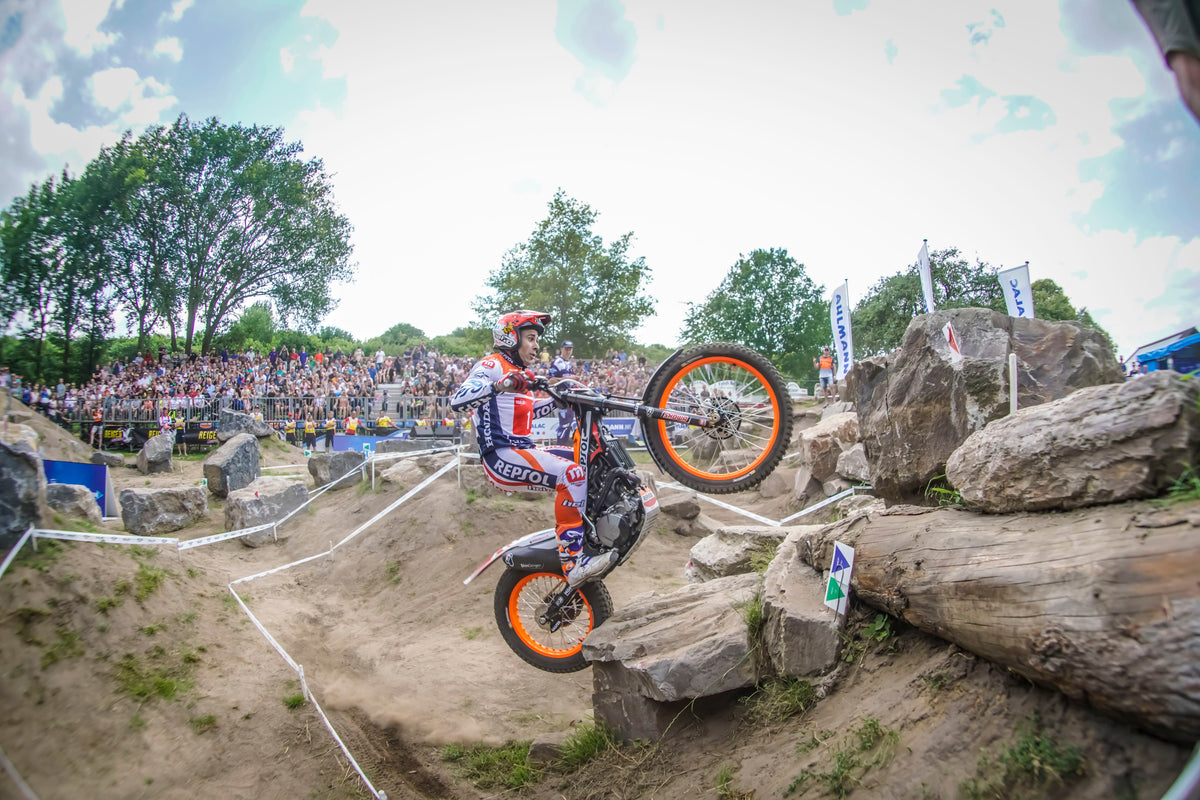
Comparison
Two-Stroke vs Four-Stroke Trials Bike: Montesa 4RT vs Beta Sincro, Sherco and TRRS for UK Riders
With Beta's Evo 4T on its last batch, Montesa is almost the only four-stroke left. We compare two-stroke and four-stroke trials bikes on power delivery, stall resistance, weight, servicing, piston and valve intervals, starting, resale and classic history, and say which suits which UK rider.
Walk the paddock at any UK club trial and you will count two-strokes by the dozen and four-strokes on one hand. Yet the most successful trials bike in history is a four-stroke: Toni Bou won his twentieth consecutive outdoor world title in 2026 on a Montesa Cota 4RT. So which should you buy? The question matters more for 2027 than it has for years. Beta's four-stroke is on its last batch, which leaves Montesa as the only four-stroke trials bike with a clear future in UK showrooms, while every two-stroke maker is adding electric start or fuel injection. This guide sets out how the two engine types really differ for a UK rider: how they deliver power, what they weigh, what they cost to run and rebuild, how they start on a frosty morning, what they are worth when you sell, and which suits your riding. We also cover the classic story, from Villiers-engined Greeves to Honda's TLRs, and where electric bikes fit.
The short answer
If you ride slippery British going, stall a lot, want long engine life and plan to keep your bike for years, a four-stroke makes a strong case. That means a Montesa Cota 4RT in practice. If you want the lightest, liveliest bike, the widest choice of brands and sizes, electric start, cheap home rebuilds and a lower purchase price, buy a two-stroke. Both win at every level of the sport. Neither is the wrong answer. The wrong answer is buying one without riding the other first.
The market for 2027: one four-stroke and a lot of two-strokes
Every current two-stroke maker is still selling bikes in the UK: Beta's new Sincro, Sherco's ST, TRRS's One, Vertigo's Nitro and GasGas's TXT, though GasGas is selling 2025 stock while it moves trials production to Austria. Four-stroke choice is thin by comparison.
- Montesa Cota 4RT 301RR and 260R. Honda's trials bikes, injected, kickstart only. The 301RR is £8,799 on the road and the 260R £6,999 at the time of writing (Honda UK).
- Beta Evo 300 4T. When Beta launched the Sincro it said the four-stroke would carry on in Evo form, and Beta UK still lists a 2026 bike. But Spanish trials site TodoTrial reports it leaves the catalogue for 2027, Beta's international website now shows only the Evo 80 youth bikes under the Evo name, and one UK dealer advertised its stock in 2026 as the "last batch" at £6,695. If you want one new, buy it now.
That is why this is really a Montesa versus the field comparison for new buyers. In the used market, there are plenty of Evo 4Ts and older 4RTs to choose from, as our used trials bike buyer's guide shows.
Specification and UK prices compared
Prices are UK RRPs or dealer list prices at the time of writing (November 2026). Weights are the makers' or dealers' claimed figures and are not measured the same way.
| Spec | Montesa 4RT 301RR (2027) | Montesa 4RT 260R (2027) | Beta Evo 300 4T (2026) | Beta Sincro 300 (2027) | Sherco 300 ST Factory (2027) | TRRS One RR (2027) |
|---|---|---|---|---|---|---|
| Engine | 298 cc four-stroke, SOHC, 4 valves | 258.9 cc four-stroke, SOHC, 4 valves | 297 cc four-stroke | 296.5 cc two-stroke, reed into cylinder | 294 cc two-stroke | Two-stroke (125, 250, 300) |
| Fuel system | Honda PGM-FI injection, two-map switch | Honda PGM-FI injection | Mikuni carburettor | Keihin PWK 28 mm carburettor | Electronic injection | Keihin carburettor or TRS injection |
| Lubrication | Separate engine oil (0.6 L, with filter) and gearbox oil (0.57 L) | Separate engine and gearbox oil | Four-stroke engine oil | Premix at 1.5% synthetic; 550 cc gearbox oil | Premix at 1%, 98 octane fuel | Premix |
| Starting | Kick only | Kick only | Kick only | Electric, with kick backup | Kick (ST); electric only (ST-E) | Kick; electric optional |
| Claimed weight | 73 kg kerb (Honda UK); 78 kg with full tank (Honda US) | 76.7 kg with full tank (Honda US) | 70.3 kg dry (US spec) | About 66 kg dry (US dealer); e-start adds 1.9 kg | About 70 kg dry (catalogue figure) | 66 kg dry; 68.5 kg with e-start |
| Seat height | 677 mm | 650 mm | 660 mm (US spec) | 670 mm | 704 mm | Not confirmed |
| Fuel tank | About 1.9 L | 1.8 L | 2.8 L | 2.6 L | 2.2 L | 2.5 L |
| UK price | £8,799 on the road | £6,999 on the road | £6,695 (dealer, run-out) | £6,995 (dealer list) | £7,999; £8,299 ST-E | About £6,849 to £7,995 |
The four-strokes are heavier on paper, and the 260R costs about the same as a Sincro 300, so price alone does not decide this.
How each delivers power
Tractability
A two-stroke fires once every revolution and spins up very quickly. That makes it easy to snap the front wheel onto a step, and it rewards a rider who uses short, sharp bursts of throttle. The cost is that a two-stroke can break traction on wet rock or slimy roots if your right hand is not delicate. A four-stroke fires every other revolution and carries more inertia in its crank. The power arrives in fatter, slower pulses that give the rear tyre time to bite. Owners and testers have described the Montesa this way since 2005, and the classic world says the same thing about Honda's TLRs: a smooth, tractor-like pull and lots of grip on wet British ground.
The gap is narrower than it was. Two-stroke makers have spent years softening their engines. Beta gave the Sincro a lighter flywheel but a heavier crank, aiming for a crisp throttle without losing the low-speed "plonk" that finds grip. Its 300 SS ("Super Smooth") uses its own header pipe to soften the bottom end, and Sherco gave its 2027 300 a new cylinder for smoother power. On the other side, Montesa has made the 301RR livelier. TrialWorld's 2020 test called it very elastic and punchy, and Trials & Motocross News described the earlier 300RR as "a lot of bike", best for riders at the top of their game. So the clean line between soft four-strokes and spiky two-strokes has blurred. A 300 SS and a 260R are closer in feel than a 301RR and a 260R are.
Engine braking
This is the four-stroke's double-edged sword. Close the throttle and a four-stroke slows the bike far more than a two-stroke does. On a steep, slippery descent that can help you hold a line, or it can lock and skip the rear wheel. Riders switching from a two-stroke often find it the hardest thing to adjust to. Montesa has worked to tame it: the 301RR has a gas decompression system, a crankcase breather enlarged from 1.9 mm to 2.25 mm in 2022 to cut engine braking further, and an ignition map tuned with it in mind. TrialWorld found the 301RR had noticeably less engine braking than earlier bikes.
Stall resistance
Stalling halfway up a section costs you five marks, so this matters. The Montesa is famously hard to stall. Its injection runs a fast idle of about 1,800 to 1,900 rpm, according to owners, and the engine plods on where a two-stroke would cough and die. The flip side, as Trials & Motocross News found, is that the fast idle means slipping the clutch to control speed in tight turns. Its suggested fix was a smaller 9-tooth gearbox sprocket. The Evo 4T has the same reputation for smooth, tractor-like running at low revs.
Among two-strokes, stall resistance varies by brand. Owners who have moved from a Beta to a TRRS on Trials Central describe the TRRS as more highly strung and the Beta as more forgiving and less likely to stall. If stalling is your weakness, it is the single best reason to look at a four-stroke, a softer two-stroke like the Sincro 300 SS, or an electric bike, which cannot stall at all.
Weight and handling
On paper the two-strokes win clearly. TRRS claims 66 kg dry for the One RR, a US dealer quotes about 66 kg for the Sincro, and GasGas claimed 69.4 kg for the TXT Racing 300. Honda UK quotes 73 kg kerb for the 301RR, and Honda US quotes 78 kg ready to ride with a full tank. TrialWorld's 2020 test treated the 73 kg figure as a dry weight and noted the 4RT had still not dipped below 70 kg. The Evo 4T sits in between at 70.3 kg dry on its US specification.
You feel that difference when you pick the bike up after a fall, haul it round a tight turn, or hop the back wheel sideways. One Evo 4T owner on Trials Central found the bike felt heavier when hopping, while still praising its smooth, tractable engine. The modern "splat" and hop style of riding, where you bounce the bike off obstacles and reposition it in the air, favours the lighter, quicker-revving two-stroke.
Weight is not everything, though. The four-stroke's weight sits low and its delivery is calm, which many clubmen find makes it feel planted rather than heavy on a long, greasy climb. And seat heights favour the four-strokes for shorter riders: 650 mm for the 260R and 660 mm for the Evo 4T, against 670 mm for the Sincro and 704 mm for the Sherco ST.
Maintenance and running costs
This is where the two designs differ most, and where the internet is full of myths. The honest picture is that a two-stroke needs more frequent but cheaper work, and a four-stroke needs more routine but rarer and dearer work.
Two-stroke: premix, gearbox oil and top ends
A trials two-stroke burns its engine oil with the fuel. You mix premix into every can of petrol (Beta specifies 1.5% synthetic for the Sincro; Sherco's sheet calls for 1% and 98 octane), change the gearbox oil, and every so often fit a new piston and rings. There are no valves to check, no oil filter and no engine oil to change.
How often does a piston need replacing? Sources disagree widely, so here is the range:
- Beta's manual, as quoted by an owner on Trials Central, lists the Evo two-stroke's piston, rings and reed valve at 80 hours and again at 200 hours, with the con rod and main bearings at 120, 240 and 360 hours.
- TrialWorld's used-bike guide suggests a new piston every 50 to 60 hours on a two-stroke.
- Owners often go much further. In the same Trials Central thread, one rider said his dealer suggested piston and rings at 500 hours, and that he had run several bikes past 300 hours without engine work. Another fits rings only if he keeps a bike more than three years.
Our reading: a clubman doing one trial a fortnight on a 250 will rarely wear out a piston as fast as the manual suggests, but a hard-ridden 300 used for practice most evenings will. The good news is that a two-stroke top end is simple. Many owners do it at home with basic tools, and the parts are cheap compared with a four-stroke's. Listen for piston slap and a rattling top end when you buy used, and ask when the piston was last done.
Four-stroke: oil, filter and valves, but long life
The Montesa runs separate engine and gearbox oils, 0.6 litres and 0.57 litres on the 301RR. There is a paper oil filter behind the flywheel cover. Owners on Trials Central reported that the manual calls for an engine oil change every 15 hours or six trials, with opinion split on whether to change the filter every time or every second change. One owner pointed out that draining removes only about three-quarters of the engine oil, which argues against stretching the interval. Owners also recommend cleaning the throttle body once a year.
Valves. Most 4RT owners say valve clearances hardly ever need adjusting. Clearances close up as they wear rather than open. One owner found an exhaust valve had tightened from 0.30 mm to 0.18 mm after about 200 hours, and the symptom was hard starting when hot. Resetting it fixed the problem. On the Evo 4T, a 2014 Trials Central thread reported plenty of tappet noise on some bikes and a dealer saying some factory valve settings had been wrong and were corrected under warranty. Check the history on a used one.
Top end. This is the four-stroke's big advantage. One Montesa owner who stripped an engine at about 500 hours found the piston only just past its service limit, and others report 700 to 800 hours without trouble. Owners point out that the 4RT engine is lightly stressed, so race four-stroke intervals do not apply. Montesa's own 2015 manual is more cautious and suggests a yearly piston inspection, so follow the book if you compete hard.
So which is cheaper to run?
Neither Honda UK nor Beta publishes a fixed service price, and dealer labour rates vary. What the owner record shows is this. A four-stroke owner spends more often on small things: engine oil, filters and the odd valve check. A two-stroke owner spends little week to week beyond premix and gearbox oil, then pays for a piston and rings at intervals that depend heavily on how hard the bike is ridden. When a four-stroke engine does need opening up, the job is bigger and the parts cost more. Our used bike guide notes that Montesa engine parts are expensive, and one owner was quoted £453 for a 2016 4RT fuel pump unit. Over five or more years, the four-stroke's long engine life tends to even out the bills. Over two years, the two-stroke is usually cheaper.
Useful categories for either type: oils, air filters, engine parts and fuel and carburettor parts.
Reliability
The Montesa's reputation is the main reason people buy one. Owner threads going back to 2005 describe superb build quality and bikes that start first kick every day of a six-day event. Trials Central regulars note that 4RT owners keep their bikes longer than two-stroke owners. Its weak points are mostly electrical and fuel-system niggles on older bikes: corroded connectors, a clogged fuel pump filter, a chafed loom near the side stand and the bank angle sensor. They are annoying, but fixable at home with patience. Our Montesa Cota 4RT 301RR review covers them in detail.
The Evo 4T has a thinner record. Owners have reported water pump impellers breaking up, a hard-to-reach carburettor and, on one 2010 bike, gear selector faults. None of these appears widespread. Two-stroke reliability depends more on the brand and model than on the engine type. The Beta Evo two-stroke built a reputation as a bike every club mechanic understands. The Sincro is too new for long-term data. Older Shercos drew reports of rattling sooner than a Beta, and some GasGas generations have known gearbox and ignition weak spots, as our GasGas TXT buying guide explains.
Noise, fuel and cold starting
Noise. The ACU's trials sound limit is 100 dBA at two metres, with random tests. In practice four-strokes have a deeper, softer note, and our Beta Sincro review notes the Montesa is the quieter bike. If you practise near neighbours or on a farmer's land, a four-stroke is more polite, though only an electric bike is truly quiet.
Fuel. A four-stroke runs on plain unleaded with no premix to measure, which is one less job and one less mistake at the fuel stop. Two-strokes need oil mixed at the right ratio, and Sherco specifies 98 octane. Tank sizes are small on every trials bike, but the 4RT's under-2-litre tank is the smallest here, and owners on long events have run dry. On a Scott-style course or a long national, check where the fuel stop is. Beta's Evo 4T has the biggest tank at 2.8 litres.
Cold starting. The injected Montesa has no choke, no jetting to change as you climb from a valley floor to a moor, and a reputation for starting first kick on a frosty morning. Hard hot starting usually points to tight exhaust valves. Carburettor two-strokes, and the carburettor Evo 4T, need a choke on cold days and can be fussier with altitude and temperature. Injected two-strokes from Sherco, Vertigo and TRRS close that gap. And the two-strokes now have one big advantage: electric start. It is standard on the 2027 Sincro 250, 300 and 300 SS, an option on TRRS, and on Sherco's ST-E models. Neither four-stroke offers it. After a fall in a stream on a cold day, a button is worth a lot. Note that the 2027 Sherco ST-E has no kickstart at all, so its battery needs looking after; see ignition and electrics.
Resale
Used 4RTs hold their value better than any other modern trials bike. UK asking prices seen recently run from about £2,000 for a 2017 260 to £4,850 for a 2023 bike and £5,999 for a 2024 301RR Repsol edition. Buyers trust the engine, and that keeps prices firm. The Evo 4T is a different case. A 2022 Evo 300 four-stroke was advertised at £3,495, against £2,999 for a 2022 Evo 300 two-stroke from the same kind of trade seller. That is healthy today, but with the model ending and no Sincro four-stroke announced, we would expect values to soften as buyers worry about parts. Two-stroke values depend on brand: Betas are easy to sell, Sherco and TRRS hold up reasonably, and GasGas values carry a question mark while the brand's future is unclear.
The classic story: four-strokes first, then the two-stroke revolution
Trials bikes did not start out as two-strokes. Until the mid-1960s the big British four-stroke singles ruled. Ariel, BSA, Matchless, AJS, Norton, Royal Enfield and Velocette 350 and 500 cc singles won the Scottish Six Days Trial (SSDT) year after year, alongside lighter four-strokes like the Triumph Tiger Cub and BSA C15. The Scottish Pre-65 Two Day Trial takes its cut-off from the 1964 SSDT, the last time a big four-stroke won it, which tells you how sharp the turning point was.
Two-strokes were already in the paddock. Greeves, James, Francis-Barnett and DOT used Villiers engines, mostly 197 to 250 cc, and Don Smith won the 1964 European Trials Championship on a Greeves. But the Villiers engine was gentle. What changed everything was the Spanish two-stroke. Bultaco's Sherpa T arrived in 1965, and Sammy Miller won the SSDT on one that year and again in 1967 and 1968. Alan Lampkin's 1966 SSDT win on a 250 BSA was the last four-stroke victory in the event for 41 years, until James Dabill won in 2007 on a Montesa four-stroke.
Japan tried to bring the four-stroke back. Honda's TL125, sold in Japan as the Bials, went on sale in 1973 as the first Japanese production trials bike, and the TL250 followed in 1975. A decade later the TLR200 (1983) and TLR250 became big sellers and are now the four-stroke choice in twinshock classes: smooth, reliable and grippy, if soft as standard. Honda's world titles with Eddy Lejeune from 1982 to 1984 came on works RTL machines, not these production bikes.
If you ride classic trials, the choice is about the class and the bike as much as the engine:
- Pre-65: a BSA C15 or Tiger Cub is the usual four-stroke start, a big Ariel or AJS for torque and grip, and a Greeves or Villiers-engined bike is the cheap two-stroke way in. See our pre-65 trials buyer's guide, and browse BSA C15, Tiger Cub, Ariel, Greeves and Villiers engine parts.
- Twinshock: the Honda TLR200 and TLR250 are the four-stroke picks for wet grip; the Fantic, Yamaha TY and Bultaco Sherpa T are the two-stroke ones. See our best twinshock trials bike guide and TLR, TL125 and TL250 and Bultaco Sherpa T parts.
- Air-cooled monoshock: almost all two-strokes. Honda's RTL250S is the rare air-cooled four-stroke mono, as our air-cooled monoshock guide explains.
Where electric fits
An electric trials bike behaves in some ways like an exaggerated four-stroke: smooth, tractable and impossible to stall, with no gears to choose. In other ways it is like a light two-stroke, with instant response. Electric Motion's 2027 Epure uses a single 2 kWh removable battery, and in 2026 two electric bikes finished in the top seven of the world championship's top class. It is silent, which opens up practice ground a petrol bike could never use, and a full charge costs well under a pound at typical UK household rates. The trade-offs are a higher purchase price, battery life and replacement cost, and planning for long events. Our electric trials bikes guide covers them in full. For a rider choosing between a two-stroke and a four-stroke mainly because of stalling or noise, it is worth a look. See Electric Motion Epure parts.
The scale: who each bike suits
Here is how the Montesa 301RR, the Beta Sincro 300 and the Beta Evo 300 4T compare for different riders. The further right the dot, the better the fit. These are our judgements from specifications, published tests and owner reports, not a timed test.
Which suits which rider and terrain?
Riders who should lean four-stroke
- Clubmen on wet British going. Welsh slate, Pennine rock, Lakeland streams and winter roots are where the soft, grippy delivery earns its keep.
- Riders who stall. The 4RT's fast idle and torque make it the most forgiving petrol bike on sale.
- One-bike-for-ten-years owners. Long engine life and strong resale justify the higher price.
- Returning riders and novices who want a four-stroke: the 260R, not the 301RR. It is smoother, lower and £1,800 cheaper.
Riders who should lean two-stroke
- Light riders and youngsters stepping up. A two-stroke 125, 200 or 250 is lighter and easier to throw about. There is no four-stroke 125.
- Aggressive riders on big steps. Quick throttle response suits the hop-and-splat style and big rock climbs.
- Anyone who wants electric start. Only two-strokes offer it.
- Home mechanics on a budget. A two-stroke top end is cheap and simple to do in a garage.
- Riders who want choice. Five brands, sizes from 125 to 300, carburettor or injection.
Terrain in brief
Slippery, slow, technical going favours the four-stroke. Big steps, logs and tight hops on grippy rock favour the two-stroke. Long-distance events such as the Scott Trial and the SSDT reward reliability and fuel range, where the four-stroke's durability helps but its small tank needs planning. See our Scottish Six Days Trial guide for what the long days ask of a bike.
The Trials Bike Classifieds verdict
For most UK clubmen, a two-stroke is still the default, and the 2027 Beta Sincro 250 or 300 SS with electric start, at £6,995, is the easiest recommendation: light, friendly, well supported and cheap to rebuild. The four-stroke case is real, not nostalgic. If you ride slippery venues, stall more than you would like, or want one bike that will run for years and hold its value, the Montesa Cota 4RT 260R at £6,999 costs the same as a Sincro and gives you grip, stall resistance and an engine owners call close to indestructible. The 301RR at £8,799 is for strong riders who want the four-stroke at its sharpest. Buy a run-out Evo 300 4T only at a sharp price, accepting that it is the end of a line.
Buying in the UK
Montesa is sold through Honda's off-road dealer network, which gives the widest four-stroke support. Beta UK in Skipton supplies Beta dealers, Sherco supplies UK dealers direct from its factory, and TRRS and Vertigo are sold through specialist dealers. Always ask for an on-the-road price: Honda's Montesa price includes registration, while one Beta dealer charged £112 for registration in 2026 and some Honda dealers add a £99 preparation fee. Ask which model year you are buying and whether the bike comes with a V5C if it is road registered.
Browse Montesa 4RT bikes for sale, Beta Evo bikes for sale (two-stroke and 4T), Beta Sincros for sale, Sherco ST bikes for sale and all trials bikes for sale. For parts, see Montesa 4RT and 301RR, Beta Evo and Evo 4T, Beta Sincro, Sherco ST, TRRS One, Vertigo and GasGas TXT, or the whole modern trials range. If you want the last two-stroke Montesa, the Cota 315R that the 4RT replaced, see Cota 315R parts.
Related reading
What to check before you buy (two-stroke or four-stroke)
- Cold start, then hot start. Ask for the bike cold. A 4RT should start in a kick or two and settle at a fast idle. Hard hot starting on a four-stroke can mean tight exhaust valves. On a two-stroke, a weak spark or flooding points to the ignition or carburettor; see ignition and electrics and fuel and carb.
- Top-end noise and history. Piston slap on a two-stroke means a top end is due. Ticking on a four-stroke is not always a problem, but ask when the valves were last checked. Receipts count. See engine parts.
- Oil records. On a four-stroke, regular engine oil and filter changes matter more than anything. On a two-stroke, ask what premix ratio the owner used. See oils and air filters.
- Clutch. Hold the bike, select a high gear and let the clutch out. It should stall. If it slips, the plates are worn. See clutch parts.
- Battery and starter. On electric-start two-strokes, check the battery holds charge and the starter spins strongly.
- Underside. Deep gouges in the sump guard mean hard use on rocks. A new sump guard is cheap insurance on either engine.
- Gearing. If you buy a 4RT and find the fast idle hard to manage in tight turns, a smaller gearbox sprocket is the classic fix; see chain and sprockets.
Frequently asked questions
Is a two-stroke or four-stroke trials bike better for a beginner?
Either can work. A four-stroke like the Montesa 4RT 260R is smoother and very hard to stall, while a two-stroke 250 or Beta Sincro 300 SS is lighter, cheaper to rebuild and available with electric start. Ride both before you buy.
Which four-stroke trials bikes can you buy new in the UK?
The Montesa Cota 4RT 301RR (£8,799 on the road) and 260R (£6,999) from Honda dealers. The Beta Evo 300 4T is a run-out model, with one UK dealer advertising its last batch at £6,695 in 2026.
How often does a two-stroke trials bike need a new piston?
Beta's manual, as quoted by owners, lists the Evo's piston and rings at 80 and 200 hours, and TrialWorld suggests 50 to 60 hours. Many club riders go much longer, so check for piston slap and keep a record of hours.
How often should I change the oil on a Montesa 4RT?
Owners quote the manual as calling for an engine oil change every 15 hours or six trials, with the paper filter changed every time or every second change. The gearbox oil is separate.
Why do four-stroke trials bikes grip better?
A four-stroke fires every other revolution and has more crank inertia, so power arrives in softer pulses that give the rear tyre time to bite on wet rock and roots. Engine braking can help on descents but takes getting used to.
Are four-stroke trials bikes heavier?
Yes. Honda UK quotes 73 kg kerb for the 301RR, while TRRS claims 66 kg dry for the One RR and a US dealer quotes about 66 kg for the Beta Sincro. The Evo 300 4T's US specification gives 70.3 kg dry.
Do any four-stroke trials bikes have electric start?
No current one does. The Montesa 4RT and Beta Evo 4T are kickstart only. Electric start is standard on the 2027 Beta Sincro 250, 300 and 300 SS and available on Sherco ST-E and TRRS models.
Which holds its value better, a two-stroke or four-stroke trials bike?
Used Montesa 4RTs hold their value better than any other modern trials bike because buyers trust the engine. Beta two-strokes also sell easily, but run-out Evo 4T values may soften now the model is ending.
More reviews & comparisons
- Trials Bike Maintenance Guide: After-Trial Routine, Service Intervals and Winter Storage for UK ClubmenA practical maintenance routine for UK trials riders: how to wash without wrecking bearings, what to check before eve...
- How to Start Trials Riding in the UK: Clubs, Licences, Kit, Costs and Your First Bike (2026/27)The complete beginner's route into observed trials in Britain: how scoring works, finding an ACU or AMCA club, 2026 l...
- Best youth petrol trials bike 2027: Beta Evo 80 Junior vs Senior, TRRS 80 and the step to 125Moving your child up from an electric bike? We compare every new and used petrol youth trials bike for UK riders, fro...