Buying guide
Electric trials bikes 2026/27: are they ready to replace your two-stroke?
Electric bikes finished in the top seven of TrialGP in 2026 and EM has a new 2027 Epure Race and Factor-e. We weigh battery life, charging, costs, ACU rules and resale to decide which UK club riders should switch now.
For years the electric trials bike was a curiosity: something you saw at a demo day, admired for its silence, and then went home to kick your two-stroke into life. That changed in 2026. Two electric bikes rode in the top class of the FIM Trial World Championship and finished in the top seven against the best petrol riders on earth. Electric Motion then unveiled a redesigned 2027 Epure Race and Factor-e. So the question for a UK clubman is no longer "do they work?" It is "should I sell my 300 and buy one?" This guide sets out what you can actually buy, what it costs to run, how it fits ACU rules, what owners complain about, and who should switch now.
The short answer
For most UK club riders in 2026/27, there is really only one brand of adult electric trials bike you can walk into a dealer and buy: Electric Motion (EM), from Vendargues in the south of France. Its trials range is now two models. The Epure Race is single-speed with a proper clutch. The Epure Factor-e adds a four-speed gearbox. Both are capable of any club route in the country in the right hands. Neither is cheap, and the long-term battery cost is still the big unknown.
GasGas, Honda and Yamaha have all raced electric trials prototypes, but none of them sells one to the public in the UK. Several petrol bikes now carry an "E" in their name, which causes confusion. On the TRRS One RR-E and Sherco ST-E, the "E" means electric start, not electric power.
What is an electric trials bike, and why does trials suit it?
A trials bike is ridden slowly, over rocks, roots, steps and streams, inside marked sections. An observer stands at each section and scores you: a clean (no penalty) if you ride through without putting a foot down, and points for each dab (a foot touching the ground) or failure. Most of the time you use small, precise amounts of power, with short bursts for a step or climb, and between sections you ride gently or queue.
That duty cycle is kind to batteries. You rarely use full throttle for long, so a pack sized for an hour of road riding can last a full club trial. MCN's Michael Guy made exactly this point when he tested the Epure Race in 2020. After two hours of riding with frequent stops, the bike still showed 65% charge.
Electric motors also deliver drive smoothly, without the power pulses of a single-cylinder engine. Visordown's tester, riding an Epure in the Ribble Valley, argued this helps the rear tyre grip on slimy climbs. And the bike cannot stall halfway up a step.
Electric Motion: the 2027 range
EM unveiled its 2027 range at the 2026 Trial des Nations in Arteixo, Spain, at the end of September. Both trials models moved to a new platform: new chassis, new battery, new cockpit and new bodywork. The headline change is the battery. The 2026 bikes used a 50.4 V pack in 1,875 Wh or 2,500 Wh sizes. The 2027 bikes use a single 2.0 kWh, 64.8 V pack in a magnesium casing that weighs 11 kg and, EM says, can be swapped in under 60 seconds.
Epure Race 2027
The Race is EM's long-running competition model, and it is not the entry-level bike the name might suggest. It has no gearbox. You get one ratio, three power maps that can be customised through the EM Connect phone app, and a three-plate hydraulic diaphragm clutch. EM's figures are 18 kW peak power (about 24 bhp), 5.31 kW nominal, and 740 Nm of torque measured at the rear wheel. That torque figure sounds huge, but it is measured at the wheel after the gearing, so don't compare it with engine torque figures for petrol bikes.
Claimed weight is 72 kg, seat height 687 mm, and top speed 80 km/h. Suspension is a Tech Racing aluminium fork with 175 mm of travel and a new Reiger two-way shock with 170 mm. Brakes are a 182 mm front disc with a four-piston caliper and a 150 mm rear disc with a two-piston caliper. Tyres are Michelin X11s on Morad rims.
Standard equipment includes TKO (a tick-over function that holds a constant motor speed, so it behaves more like a petrol bike at idle), FRB (a fixed regenerative brake), an anti-reverse system that locks the rear wheel to stop you rolling backwards, and a TFT display.
Epure Factor-e 2027
The Factor-e is EM's flagship, and the bike Benoît Bincaz raced in TrialGP in 2026. It shares the new chassis, battery, brakes and maps with the Race. The difference is a four-speed gearbox. EM describes first gear for slow technical sections, second for faster natural going, third for trail riding and fourth for road transfers. Torque is quoted at 1,400 Nm in first gear, peak power 18 kW, and top speed 85 km/h. Claimed weight is 73 kg.
For 2027 the Factor-e also gets multi-position triple clamps with four settings, a handlebar power button and a "Trial Mode" on the TFT with a built-in section timer. EM says you can run one 2.0 kWh battery or carry a second for 4.0 kWh, and it mentions a battery rental programme. We could not find UK details of that scheme.
Escape models
EM also sells the Escape family, which is built for trail and off-road riding rather than competition. The 2027 Escape R has a proper seat, an 820 mm seat height, a 3.8 kWh battery, a claimed 87 kg and a four-hour maximum range. It is a trail and practice bike, not a competition trials machine.
What about the 2026 bikes still in dealers?
The 2026 Epure Race came with a 1,875 Wh or 2,500 Wh battery, weighed a claimed 74 kg, and EM quoted up to four hours of riding. The 2027 claim is 3.5 hours from a smaller 2.0 kWh pack. EM says the new high-voltage battery holds its performance better as charge drops, but a run-out 2026 Race 2.5 stores more energy. For long practice days, a discounted 2026 bike may suit you better. If you carry a spare battery, the lighter, quick-swap 2027 pack is the better system.
The clutch: the thing that made electric trials serious
The first electric trials bikes were twist-and-go. Fine for a novice, but an expert uses the clutch constantly, slipping it for grip on a wet rock or dumping it to fire the bike up a step. EM's answer was a real friction clutch. On the Race and Factor-e it is a three-plate diaphragm clutch with hydraulic operation, running in transmission oil, just like a petrol trials bike. EM also fits a flywheel and lets you change its inertia with balancing weights, which affects how the bike "carries" when you snap the clutch.
MCN rated the clutch as perhaps the most important advance in electric trials so far. Its tester said that by the end of the day he "didn't want to go back" to petrol. Not everyone agrees it is essential, though. One Trials Central owner said he never uses the clutch on his Epure Race and planned to move to a clutchless model. Another owner of a 2021 Race said the bike can feel too free-running when you shut the throttle, because there is less engine braking than on a petrol bike. That's the one handling difference most owners mention.
Specification
| Spec | EM Epure Race (2027) | EM Epure Factor-e (2027) | GasGas TXT Racing 300 (2025 spec, UK dealer) |
|---|---|---|---|
| Power source | EM-designed electric motor | EM-designed electric motor | 294.1 cc liquid-cooled two-stroke single |
| Peak power | 18 kW (5.31 kW nominal) | 18 kW (5 kW nominal) | Not listed by the dealer |
| Torque | 740 Nm at the rear wheel | 1,400 Nm at the rear wheel in first gear | Not listed by the dealer |
| Gearbox | None (single speed) | Four-speed | Six-speed |
| Clutch | Three-plate diaphragm, hydraulic | Three-plate diaphragm, hydraulic | Braktec hydraulic, diaphragm |
| Energy | 2.0 kWh Li-ion, 64.8 V, 11 kg, removable | 2.0 kWh Li-ion, 64.8 V, 11 kg, removable | 2.4 litre fuel tank |
| Claimed run time | Up to 3.5 hours | Up to 3.5 hours | Refuel as needed |
| Charge time | 2h55 full (12 A), 1h33 from 20% to 80%; 1h55 with optional 18 A charger | Same as Race | Not applicable |
| Weight | 72 kg | 73 kg | 69.4 kg without fuel |
| Seat height | 687 mm | 687 mm | Not listed by the dealer |
| Wheelbase | 1,320 mm | 1,320 mm | 1,320 mm |
| Suspension travel | 175 mm front, 170 mm rear | 175 mm front, TECH TJ2 shock rear | 160 mm front, 174 mm rear |
| Brakes | 182 mm disc, 4-piston front; 150 mm disc, 2-piston rear | 182 mm disc, 4-piston front; 150 mm disc, 2-piston rear | Braktec with Galfer discs |
| Power maps and aids | 3 maps (customisable), TKO tick-over, regen brake, anti-reverse | As Race, plus TFT Trial Mode with section timer | Not listed by the dealer |
| Top speed | 80 km/h | 85 km/h | Not listed by the dealer |
| UK price | Not confirmed at the time of writing | Not confirmed at the time of writing | £6,999 (Drysdale Motorcycles listing) |
EM figures are from its 2027 model pages. The GasGas figures are from a UK dealer's listing of the current TXT Racing 300, which describes 2025 updates. With 2.4 litres of fuel on board, the GasGas will weigh around 71 kg by our estimate, roughly the same as the electric bikes, which matches MCN's conclusion back in 2020: once you count fuel, coolant and oil, the weight gap all but disappears.
How much do they cost in the UK?
This is the area where we have least certainty. EM's UK dealer listings showed prices in converted currencies when we checked, so we could not confirm a sterling RRP for the 2027 Race or Factor-e. Here is what we could verify:
- Older UK prices: MCN listed the Epure Race at £7,995 on the road in 2020. Visordown quoted £6,899 for the Epure range in the same year.
- European prices: Spanish dealer Trialworld listed the 2026 Factor-e at €11,850, and the Factor-e Pilot Edition at €12,900, in its 2025 launch article.
- US prices: EM USA lists the 2026 Epure Race 2.5 at $11,799 and the Race 1.8 at $11,299, before freight and taxes.
- Petrol for comparison: UK dealers list the GasGas TXT Racing 300 at £6,999. The 2027 Beta Sincro 300 2T has an RRP of £6,995 at John Lee & Sons.
Even without a confirmed sterling figure, a new EM clearly costs more than a new 300 two-stroke. Ring the importer for a current price and ask what charger, battery and warranty terms are included.
Running costs: electricity vs two-stroke
Energy is almost free. A full 2.0 kWh charge costs well under a pound at typical UK household tariffs. Work out your own figure by multiplying 2 kWh by your price per kWh, and allow a little extra for charger losses. A two-stroke needs fuel, pre-mix oil (Beta specifies 1.5% synthetic in the Sincro), gearbox oil, plugs, air filters and, sooner or later, a top-end rebuild.
EM bikes still need maintenance. You will be buying chains, sprockets, brake pads, tyres, wheel bearings, clutch plates and transmission oil. The UK EM parts site lists Motul ATF VI transmission oil at £18 a litre, a Race clutch pack (2020 to 2024 models) at £283.92, and Factor-e clutch friction plates at £152.08. Electrical parts are where it gets expensive: a 2025 Factor-e and Race controller is listed at £1,000, a 2020 to 2024 charger at £315.02 and a Domino throttle assembly at £169.
Battery life and replacement
EM rates its batteries at 1,000 charge cycles. If you ride 50 times a year and recharge once each time, that's 20 years on paper. In practice, all lithium batteries lose capacity with age as well as use, and EM does not say how much capacity remains after 1,000 cycles. Store it sensibly and don't charge it below freezing. EM's minimum charging temperature is 0°C, which matters on a frosty February morning in the Pennines.
We could not find a current UK price for a replacement 2.0 kWh battery. Trials Central owners describe EM packs as expensive, and one said the battery price was the main thing putting him off. EM UK lists a refurbished cell pack for the old EM 5.7 at £499, which shows refurbishment is possible for older packs. Before you buy, ask the importer for a written price for a spare battery. It is the single biggest number in your ownership costs, and it decides your resale value too.
Charging at events
The ACU has started to write electric bikes into its rules. The 2025 Trials Standing Regulations, the latest edition we could read in full, say:
- Organisers are recommended to provide a specific area for recharging electric machines. Where they can't, bikes should be charged away from vehicles, and any generator must stand on an environmental mat.
- The Clerk of the Course must make sure the course is the right length for electric machines to complete a full lap without recharging.
- Standard fire extinguishers must not be used on electric machines.
- Machine examiners are expected to understand the specific requirements of electric bikes.
In practice, most UK club trials don't have mains power in the paddock. For a typical one-day trial, a fully charged battery should cover you, given EM's 3.5-hour claim and MCN's 65% figure after two hours. For a long two-lap national or a day at a trials park, carry a second battery and swap it. A generator works but brings back the noise and fuel you were trying to avoid.
Multi-day events are a bigger logistical job. When Gaël Chatagno rode an Epure in the 2022 Scottish Six Days Trial, he finished 19th, won the best up-to-200cc award, and was named best foreign rider. TrialGP's report said EM proved the bike could be recharged quickly despite the logistical challenges. That was a factory effort with support. A privateer at the SSDT or Scott Trial would need a careful plan.
ACU rules and classes for electric bikes
For adults, the ACU rules are simple. Adult classes and routes are not divided by engine size, and the 2025 regulations say capacity restrictions don't apply when riding as an adult. You choose your route (Expert, Clubman, Novice and so on) by ability, as you would on a petrol bike. Check each club's supplementary regulations, but an EM Race or Factor-e can enter an adult club trial.
Youth classes are different. The ACU sets power limits for electric machines, measured at the rear wheel:
- A and B classes: electric up to 10 bhp.
- C and D classes: electric up to 7 bhp.
- E class: small-wheel electric machines up to 2 bhp. Riders can start in E class from age four.
A full-size EM makes 18 kW peak, roughly 24 bhp, so a youth rider on one would need it restricted to meet the 10 bhp limit. We could not confirm how EM or the importer certifies a restricted setting, so ask before you buy. Sixteen-year-olds can choose to ride as adults, where the limits don't apply. For younger children, see our guide to kids' electric trials bikes in the related reading below.
The ACU sound limit for trials machines is 100 dBA at two metres, with random tests. An electric bike will never trouble the noise meter.
Noise, neighbours and practising on private land
Silence is the electric bike's biggest everyday advantage. There is no exhaust, so what you hear is mostly the drivetrain and tyres. That makes it much easier to practise in a field or wood without upsetting the neighbours, and some landowners who would never allow a two-stroke may agree to an electric bike.
Quiet doesn't mean exempt, though. In England, the permitted development rules allow land to be used for motorcycle racing, trials and practice for those activities on no more than 14 days a year without planning permission, and not at all on a Site of Special Scientific Interest. Those rules apply to motorcycle sport in general and make no exception for electric bikes. Wales and Scotland have their own rules. If you plan to practise regularly on one piece of land, talk to the landowner and check with the local planning authority.
Wet weather and water crossings
British trials means mud, rain and streams, so this is a fair worry. Here is what we know. Electric bikes have finished the SSDT, one of the wettest events in the sport, with Chatagno's 19th place in 2022. Visordown's tester spent an afternoon climbing a flowing, rock-filled stream in Lancashire on an Epure. EM sells battery casing gaskets and seals as spare parts, which tells you the battery is designed to be sealed.
What we could not find is a published waterproof (IP) rating for EM's 2027 bikes. EM's warranty also excludes damage caused by liquids and flooding. So ride through streams the way the bike is designed to be used, but don't submerge it for long, don't pressure-wash the connectors, charge port or controller, and check the battery seals whenever you take the pack out. If a bike has been dropped in deep water, have it checked before charging it.
The warranty: read the small print
EM's published warranty terms are worth reading, new or used. The period depends on the product, the bike must be registered on EM's website, and cover passes to a new owner only if EM is told of the sale. Work must be done by EM or an authorised dealer, with servicing proven against the owner's manual.
Two exclusions stand out for trials riders. EM's terms list participation in sporting competitions among the "abnormal" uses that can limit cover, and they exclude damage from shocks and falls. Ask the importer how competition use affects your warranty, and get the answer in writing.
The FIM TrialE story, and electric bikes in TrialGP
The FIM ran a separate electric class, the TrialE Cup, alongside the World Championship. Marc Colomer, the 1996 world champion who now leads EM's R&D department, won the first one in 2017 for EM. Loris Gubian won in 2018 on a GasGas, beating Yamaha's Kenichi Kuroyama and the TY-E prototype on a tie-break. Albert Cabestany won in 2019 on a GasGas. Gaël Chatagno finished second for EM in 2020 and won the title in 2021.
After that, the separate class was dropped and electric bikes started competing directly against petrol bikes. EM put Chatagno into Trial2 in 2022. In 2024 GasGas entered Sondre Haga on the TXE prototype, and he won a Trial2 round in Japan. In 2025 Honda's RTL Electric prototype, ridden by Miquel Gelabert, finished runner-up in Trial2 with five wins and nine podiums.
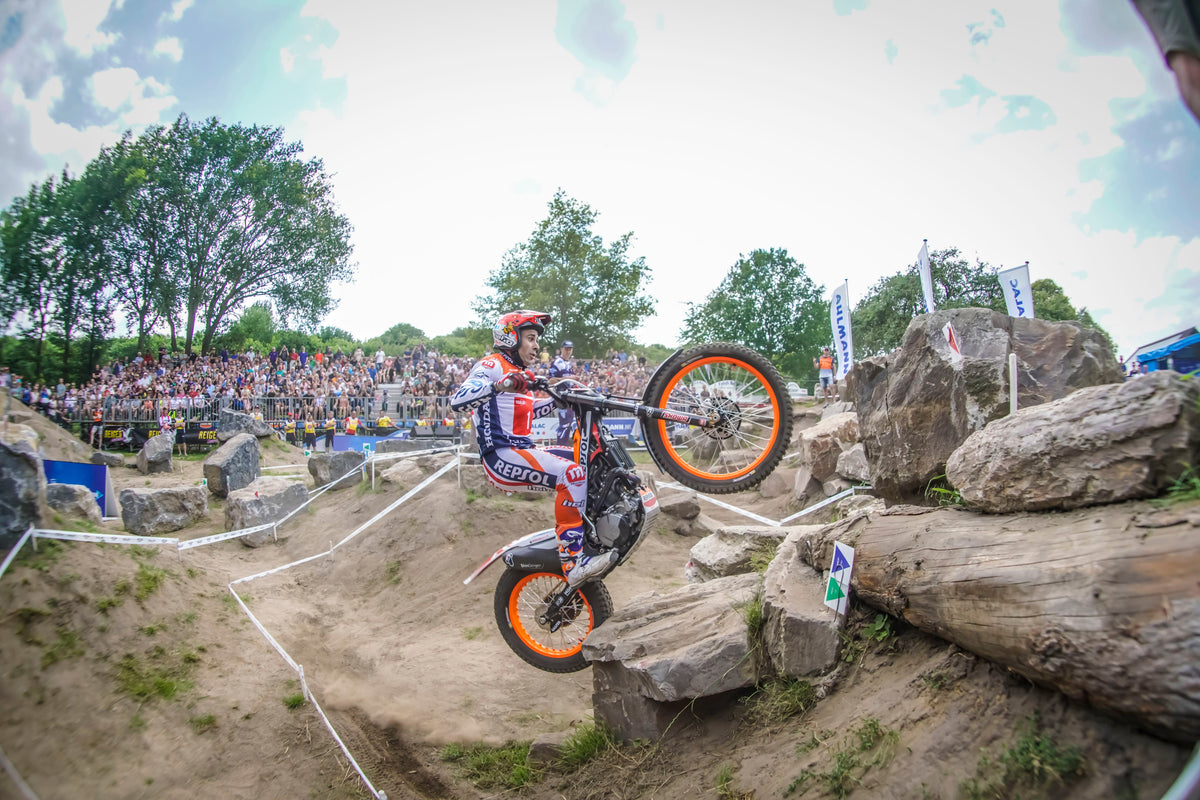
In 2026, electric bikes moved into TrialGP, the top class. Gelabert took the Honda to sixth and fifth overall on the two days of the opening round at Motegi in Japan. Benoît Bincaz rode the EM Factor-e and finished sixth and seventh at the British round on Anglesey in July. Those are proper results against the best riders in the world.
GasGas TXE: where is it now?
GasGas's own TXE prototype page says the bike runs a diaphragm clutch with three preload settings, a tick-over function and Braktec hydraulics, with geometry close to the petrol TXT. It also says the bike still needs development before it reaches production, and it gives no sale date. In October 2025 GasGas announced it would not field a factory team in TrialGP or the Spanish championship from 2026, as part of KTM Group's restructuring. GasGas said its commercial trials business continues, but there has been no 2026 news of the TXE going on sale. You are unlikely to find one for sale in the UK.
Honda, Yamaha and the rest
Honda's RTL Electric remains a racing prototype with no confirmed production date. Yamaha's TY-E has only ever been a development and competition machine. Mecatecno has shown an electric Dragonfly, but it is not confirmed as on sale in the UK in 2026. Sherco, Beta, Vertigo and TRRS have no adult electric trials bike. Beta does make electric Minitrial bikes for children.
Buying a used electric trials bike: what to check
Used EMs are starting to appear in bigger numbers, and they are noticeably cheaper than new. In autumn 2026, aggregated listings showed 2020 to 2022 Epure Races in France advertised at roughly £2,900 to £4,600 when converted, and a 2025 Factor-e 2.5 in Devon at £5,700. Depreciation is steep, which is good news for buyers and bad news for anyone buying new. Owner threads on Trials Central point to these checks:
- Battery health: ask how old the battery is, how it has been stored and charged, and whether the dealer can read its condition. The battery is the most expensive part of the bike.
- Charger and lanyard: make sure the correct charger comes with the bike, along with the magnetic kill-switch lanyard. EM UK lists a replacement lanyard unit at £99.
- Battery compatibility: the 2027 battery runs at 64.8 V. Earlier Epure batteries were 50.4 V. Don't assume packs or chargers are interchangeable between generations.
- Throttle behaviour: one owner of a 2022 Race reported revs hanging, as if tick-over were on when it wasn't. A worn throttle sensor was suggested as the cause. Rev it in every map.
- Drive noise: a grinding noise under power can be a bearing, but one owner traced his to poor rear wheel alignment, as the snail cams differ side to side. Check the chain line.
- Clutch: check the clutch fluid and transmission oil. One owner's clutch stopped engaging after the cover was removed and oil was lost.
- Warranty transfer: ask whether the bike is registered with EM and whether the previous owner informed EM of the sale.
- Paperwork and insurance: if the bike is road registered, check the V5C. A UK owner on Trials Central struggled to find mainstream insurers who would even quote for a Factor-e, so get quotes before you buy.
Browse Electric Motion Epure bikes for sale and the wider trials bikes for sale section to see what's out there.
Electric vs petrol: the head-to-head
EM Epure Race vs a petrol 300 two-stroke
A modern 300 two-stroke like the GasGas TXT Racing 300 or Beta Sincro 300 costs less to buy and is cheaper to resell. It refuels in a minute anywhere in the country, every dealer and club mechanic knows how to fix it, and long trials and multi-day events need no planning. The Race is quieter, has no gears to choose, never stalls, and costs pennies to "fill up". For practice it's in a different league. For a one-day club trial it is now competitive. Choose the petrol bike if you ride long or multi-day events, have a tight budget, or want easy resale. Choose the Race if you mostly practise near houses, ride one-day club events and value simplicity. See GasGas TXT Racing and GP parts.
EM Epure Race vs Epure Factor-e
The Factor-e adds a gearbox, which gives you a choice of ratio for a big step, a fast natural section or a road transfer. The Race is simpler and a claimed kilogram lighter. Many club riders will be happy on the Race. If you ride long road sections between sections, or you're coming from petrol and want the familiar feel of choosing a gear, try the Factor-e.
Who electric suits: the scale
Here's how the 2027 Epure Race compares with the Factor-e and a petrol 300 two-stroke for different kinds of rider. The further right the dot, the better the fit.
Who should switch to electric now?
- Riders who practise at home or near houses: the strongest case. Silence opens up places to ride that a two-stroke never could.
- Novice and Clubman riders doing one-day club trials: a good choice if the budget allows. No stalling and no gear choice make learning easier.
- Returning riders and older riders: worth a test ride. No kick-starting, a smooth, predictable delivery and less maintenance are real benefits.
- Experts on hard routes: the bikes are capable, as TrialGP showed in 2026. Try a Factor-e back to back with your petrol bike before deciding.
- Riders who do the SSDT, Scott or long two-lap nationals: stay with petrol for now, or keep a petrol bike for those events.
- Twinshock and pre-65 riders: not relevant to your classes. An electric bike might make a quiet practice bike, but a classic trial needs a classic.
- Riders on a tight budget: a used petrol bike is still far cheaper to buy and to resell.
The Trials Bike Classifieds verdict
Electric trials bikes are ready for UK club trials. The 2027 Epure Race and Factor-e have a proper clutch, enough battery for a one-day event, competitive weight and results at world level to prove the concept. For practice, nothing petrol comes close for silence or simplicity. What holds them back is money and uncertainty: a higher purchase price, an unconfirmed UK RRP at the time of writing, an unknown long-term battery cost, steep depreciation, and warranty small print that needs clarifying for competition use. If you mostly practise near home and ride one-day club trials, and you can afford it, switching now makes sense. Book a test ride, get the battery and warranty answers in writing, and look hard at nearly-new 2026 stock. If you ride long or multi-day events, or you need to watch every pound, keep your two-stroke for another year or two.
Availability in the UK
Electric Motion's dealer finder lists Inch Perfect Trials, at Whitewell near Clitheroe in Lancashire, as its UK outlet. Inch Perfect has run EM test days with local clubs, such as one in Dorset in 2025, and in 2025 it hosted training sessions with the EM factory team at Kettering after the British TrialGP round. The UK EM parts site stocks a wide range of service parts for 2020-onwards Epures. Ask about 2026 run-out stock and demonstrators as well as 2027 bikes, because discounted earlier models can be very good value. For used bikes, keep an eye on Electric Motion Epure bikes for sale, and for the older generation see EM 5.7 bikes for sale.
Related reading
- Best trials bike 2027: group test
- Beta Sincro review
- Triumph TXP review: kids' electric trials bikes compared
The first parts to fit
- Frame and battery protection. Your battery and controller are the most expensive parts on the bike. Look at frame guards and protection and sump guards.
- Tyres. The standard Michelin X11s are a good trials tyre. Keep a spare rear and check pressures for British mud. See trials tyres.
- Levers. Folding, adjustable levers survive falls better. EM bikes use Braktec controls. See levers.
- Brake pads. Regenerative braking takes some load off the rear, but you will still wear pads in wet, gritty sections. See brakes.
- Chain and sprockets. On a single-speed Race, the rear sprocket is your only gearing adjustment, and owners do change it. See chain and sprockets.
- Handguards and grips. Protect your hands and the switchgear. See grips and handlebars.
- Transmission oil and tools. Keep the right oil and a basic kit in the van. See oils and tools.
Browse everything matched to these bikes in our Electric Motion Epure parts section, or see all modern trials parts. Many service parts change between generations, so check each listing's fitment against your bike's year before you buy.
Frequently asked questions
Can you ride an electric trials bike in an ACU club trial?
Yes. The ACU's 2025 Trials Standing Regulations say capacity restrictions don't apply when riding as an adult, so an Electric Motion Epure Race or Factor-e can enter adult routes. Youth classes have power limits for electric bikes, measured at the rear wheel.
How long does an Electric Motion Epure Race battery last?
EM claims up to 3.5 hours of riding for the 2027 Epure Race and Factor-e with the 2.0 kWh battery. MCN found its 2020 test bike still had 65% charge after two hours of stop-start trials riding.
How long does it take to charge an electric trials bike?
EM quotes 2 hours 55 minutes for a full charge of the 2027 battery on the standard 12 A charger, 1 hour 33 minutes from 20% to 80%, and 1 hour 55 minutes with the optional 18 A charger.
How much does an electric trials bike weigh?
EM claims 72 kg for the 2027 Epure Race and 73 kg for the Factor-e. A GasGas TXT Racing 300 is listed at 69.4 kg without fuel, so the difference is small once a petrol bike is fuelled.
Does the Electric Motion Epure Race have a clutch?
Yes. The Race and Factor-e both use a three-plate diaphragm clutch with hydraulic operation, like a petrol trials bike. The Race is single-speed, while the Factor-e adds a four-speed gearbox.
Is the GasGas TXE electric trials bike on sale?
Not that we could find. GasGas's own TXE page describes it as a prototype still in development with no sale date, and GasGas withdrew its factory trials team from 2026.
What is the ACU power limit for youth electric trials bikes?
The 2025 ACU regulations allow electric machines up to 10 bhp in A and B classes, up to 7 bhp in C and D classes, and up to 2 bhp on small wheels in E class, all measured at the rear wheel.
Who imports Electric Motion trials bikes into the UK?
Electric Motion's dealer finder lists Inch Perfect Trials, at Whitewell near Clitheroe in Lancashire, as its UK outlet. Contact it for current prices and test rides.
More reviews & comparisons
- Trials Bike Maintenance Guide: After-Trial Routine, Service Intervals and Winter Storage for UK ClubmenA practical maintenance routine for UK trials riders: how to wash without wrecking bearings, what to check before eve...
- Two-Stroke vs Four-Stroke Trials Bike: Montesa 4RT vs Beta Sincro, Sherco and TRRS for UK RidersWith Beta's Evo 4T on its last batch, Montesa is almost the only four-stroke left. We compare two-stroke and four-str...
- How to Start Trials Riding in the UK: Clubs, Licences, Kit, Costs and Your First Bike (2026/27)The complete beginner's route into observed trials in Britain: how scoring works, finding an ACU or AMCA club, 2026 l...
- Best youth petrol trials bike 2027: Beta Evo 80 Junior vs Senior, TRRS 80 and the step to 125Moving your child up from an electric bike? We compare every new and used petrol youth trials bike for UK riders, fro...