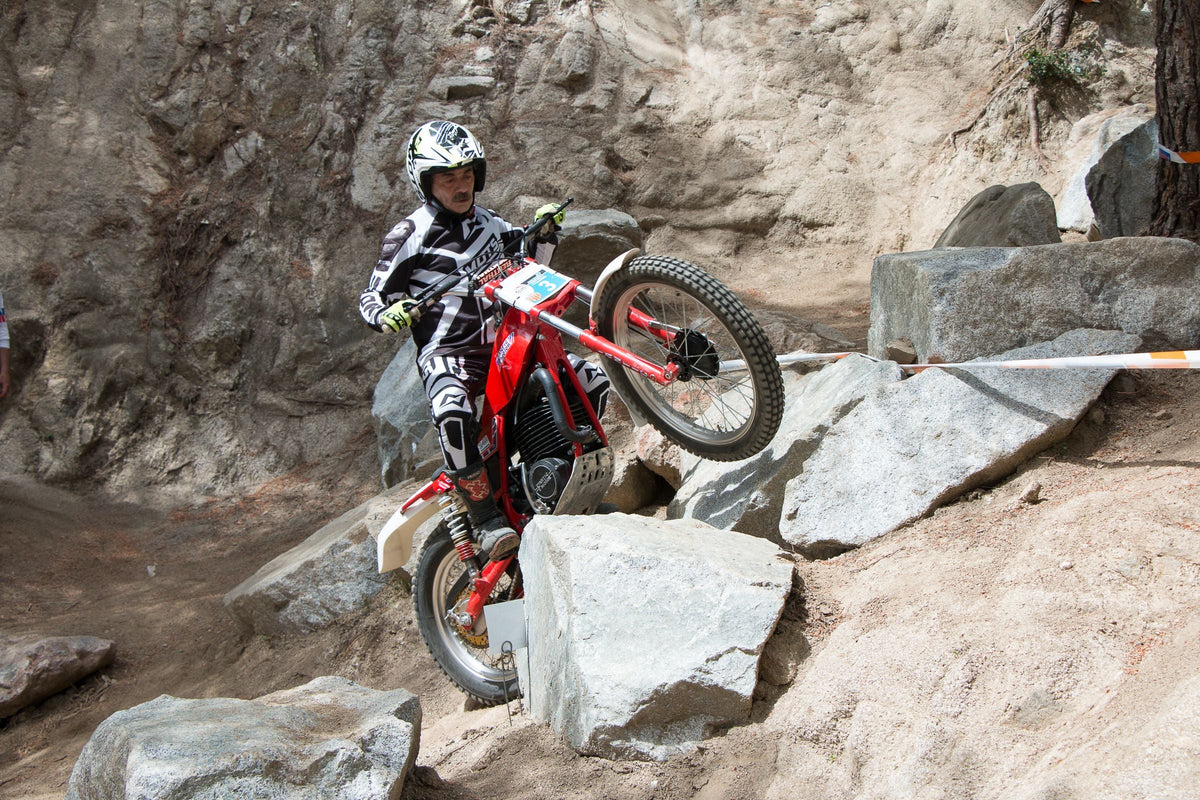
Review
Beta Sincro review: the Evo's replacement tested against TXT, Cota 4RT and Sherco
Beta's all-new Sincro replaces the long-running Evo, and the 2027 bikes bring electric start to the 250 and 300. We weigh up what's really new, what it costs in the UK, and whether a used Evo is the smarter buy.
For sixteen years, if you turned up at a club trial in the UK, there was a fair chance the bike next to yours was a Beta Evo. It launched in 2009, it won at every level from Clubman to TrialGP, and it became the default second-hand buy for anyone getting back into the sport. Now it has gone. Beta has retired the Evo name from its adult two-stroke range and replaced it with the Sincro, its first clean-sheet trials bike in well over a decade. The first Sincros arrived as 2026 models, the updated 2027 bikes are in UK dealers now with electric start on the bigger engines, and the used market is suddenly full of nearly new Evos. So the question for UK riders is simple: is the Sincro worth nearly £7,000, or is a run-out or second-hand Evo the smarter buy? Here's our full review for UK riders.
What is the Beta Sincro?
The Sincro is Beta's new family of competition two-stroke trials bikes. The name comes from the Italian for "synchronised", and Beta's pitch is that the bike and rider work together better than before. Underneath the marketing, it is a genuinely new motorcycle. Beta says the only engine dimensions carried over from the Evo are the 300's bore and stroke, 79.0 x 60.5 mm. The crankcases, cylinder, head, clutch, gearbox, cooling system, swingarm, fork internals and bodywork are all new, and the frame has been reworked.
What hasn't changed is the basic recipe that made Beta's trials bikes so popular. It is still a hydroformed aluminium single-beam frame with the fuel tank built inside it, a layout Beta has used on its trials bikes since 1990. The engine still acts as a stressed part of the chassis. It still runs a Keihin carburettor, and from ten paces it still looks like a Beta.
A quick note on naming, because it confuses people. Beta announced the Sincro in late September 2025 as a 2026 model. The 300 came first, around December 2025. The higher-spec Sincro Factory versions were launched in March 2026. Then in October 2026 Beta revealed the 2027 Sincro, which is a development of the same bike, not another new one. Both share the same frame and core engine.
The range: every model and capacity
The line-up differs by market and model year. Here's what the UK importer, Beta UK in Skipton, lists at the time of writing, alongside UK dealer prices.
| Model | Engine | Start | UK price (dealer list, Nov 2026) |
|---|---|---|---|
| Sincro 2T 125 (2027) | 124.8 cc two-stroke | Kick only | £6,445 |
| Sincro 2T 200 (2027) | 200.65 cc two-stroke | Kick (e-start kit optional) | £6,745 |
| Sincro 2T 250 / E-Start (2027) | 249.7 cc two-stroke | Electric plus kick | £6,995 |
| Sincro 2T 300 / E-Start (2027) | 296.5 cc two-stroke | Electric plus kick | £6,995 |
| Sincro 2T 300 SS (2027) | 296.5 cc, softer "Super Smooth" delivery | Electric plus kick | Not yet listed by UK dealers we checked |
| Sincro Factory 125 / 200 (2026) | Two-stroke, Factory spec | Kick | £7,095 / £7,395 |
| Sincro Factory 250 / 300 (2026) | Two-stroke, Factory spec | Kick (e-start kit optional) | £7,645 |
| Evo 80 Junior / Senior (2026) | 80 cc two-stroke youth bikes | Kick | £3,895 / £4,095 |
| Evo 4T 300 (2026) | 297 cc four-stroke | Kick | Around £6,695 where still available |
Prices come from UK dealer lists (John Shirt Motorcycles, Acklams Beta and John Lee Motorcycles) at the time of writing. Beta UK doesn't publish prices on its own site, dealers quote on slightly different terms, and road registration is usually extra (around £112 including tax at the dealers we checked). Always ask for an on-the-road figure.
Two things are worth flagging. First, the 200. Beta's international website lists only the 125, 250, 300 and 300 SS for 2027, but UK, US and Australian dealers all list a 2027 Sincro 200, so it is clearly being built for those markets. Second, the four-stroke. There is no Sincro four-stroke. When the Sincro launched, Beta said the Evo 300 4T would carry on in updated Evo form, and Beta UK still lists a 2026 Evo 4T 300. But Spanish trials site TodoTrial reports that the 300 4T leaves the catalogue for 2027, and one UK dealer has described its current stock as the last batch. If you want a new Beta four-stroke, don't wait.
The Evo 80 Junior and Senior carry on, and Beta says they will keep being developed alongside the Sincro. The Junior is for young riders new to petrol trials bikes. The Senior uses full-size wheels in a smaller chassis and bridges the gap to the Sincro 125. US coverage puts the Junior at roughly ages 9 to 11 and the Senior at 11 to 15.
Specification: Sincro 2T 300 (2027)
| Spec | Beta Sincro 2T 300 / E-Start (MY2027) |
|---|---|
| Engine | 296.5 cc single-cylinder two-stroke, liquid-cooled, reed intake direct into the cylinder |
| Bore × stroke | 79.0 × 60.5 mm (the only dimensions carried over from the Evo) |
| Compression ratio | 10.5:1 (Beta MY2027 data; other sources quote slightly different figures) |
| Carburettor | Keihin PWK 28 mm |
| Ignition | Hidria 12V 110W, two selectable maps, NGK CMR7H plug |
| Lubrication | Premix at 1.5% synthetic oil; gearbox 550 cc of SAE 10W-30 |
| Gearbox and clutch | 6-speed; wet multi-plate clutch with diaphragm spring and three preload positions |
| Frame | Hydroformed single-beam aluminium, fuel tank integrated, engine as stressed member |
| Front suspension | R16V 39 mm hydraulic fork, 10 mm narrower tube spacing than the Evo, 165 mm travel |
| Rear suspension | Aluminium-bodied monoshock with linkage, 180 mm wheel travel |
| Brakes | 185 mm disc, four-piston caliper (front); 160 mm disc, two-piston caliper (rear) |
| Wheels and tyres | 21 x 1.6 front, 18 x 2.15 rear; 2.75-21 and 4.00 R18 tyres |
| Wheelbase | 1,310 mm |
| Seat height | 670 mm |
| Ground clearance | 315 mm |
| Footrest height | 348 mm |
| Fuel capacity | 2.6 litres (optional Long Range kit adds around 4 litres) |
| Weight | Not published by Beta; e-start adds 1.9 kg (see below) |
| UK importer | Beta UK, Skipton, North Yorkshire |
| UK price | £6,995 at UK dealers, plus registration if wanted |
What's actually new
Frame and chassis
Beta kept the concept but redesigned almost every piece of the frame. There are new forged sections front and rear, a stronger steering head area with fewer welds, and new engine mounting points. Beta says this makes the chassis stiffer in both bending and twisting than the Evo's, while the bike overall is slimmer and lighter. The steering angle is also more open than before. The airbox now sits inside the tapered frame on two forged brackets and is made in two parts rather than one.
The rear shock's top mount has moved forward, with new linkage mounts to make the rear suspension more progressive. Beta claims this reduces rider fatigue over rocks. Wheel travel is unchanged. The new swingarm is about 100 g lighter, with variable wall thickness and fewer welds. The triple clamps are now one-piece forgings.
Engine
The engine is the biggest change. Here is what Beta has done and why it matters to a clubman:
- New crankcases with the kickstart on the right. The kick lever has moved to the right-hand side, where most riders expect it, and the final drive chain is on the left.
- Reed valve on the cylinder. The intake now feeds straight into the cylinder rather than the crankcase. Beta says this sharpens low-speed response and widens the useful power band. It also frees space for the electric starter.
- Lighter flywheel, heavier crank. The flywheel is smaller and lighter, while the crankshaft itself is heavier, and the crank sits 2 mm lower relative to the swingarm pivot. The aim is a crisp throttle without losing the "plonk" that finds grip on slippery rock.
- One-piece cylinder head and magnesium covers. Beta claims the complete engine is nearly 800 g lighter than the Evo's.
- New clutch. A diaphragm spring replaces the old coil springs, with smaller plates and three mechanical preload settings. That lets you choose a lighter lever or firmer bite, which is useful because clutch control is half of trials riding.
- Six-speed gearbox, more compact, with a revised primary ratio.
Cooling
The external coolant hoses have gone. Coolant runs through passages inside the engine, with a nylon insert in the clutch cover keeping coolant away from the clutch. The radiator is smaller and tilts forward on its lower pins when you undo a knob, which hides the filler cap from rock strikes. Fewer hoses means less to snag on a Lakeland boulder.
Suspension
The R16V fork has its tubes 10 mm closer together, new outer tubes, a shorter stem, lighter 5W oil and revised damping. The shock gains a nitrogen valve and keeps rebound and preload adjustment. For 2027 Beta has revised the internal settings front and rear, but it hasn't published what changed.
Electric start
This is the headline for many UK riders. On the 2026 bikes, electric start was an optional Factory kit, not available on the 125, with the battery behind the headlight mask. The crankcase covers are designed to take it later without visible changes. For 2027 it is standard on the 250, 300 and 300 SS, available as a kit on the 200, and still not offered on the 125. The system adds 1.9 kg, and every e-start bike keeps its kickstart as a backup. Beta itself positions the e-start bikes for less specialist use, with kick-only versions for purists chasing every gram.
The 2027 changes
Beyond electric start, the 2027 Sincro gets a redesigned cylinder head and combustion chamber with a smaller CMR7H spark plug mounted vertically, updated ECU hardware and mapping on all models, and a new silencer on the 300 and 300 SS with a straighter internal path. The 300 SS keeps its own exhaust header pipe to soften its bottom end. Graphics move to black and red. There's also an optional Long Range kit, a new seat and tank combination for the Sincro chassis that adds around 4 litres. It's aimed at trail riding, but could suit a long day like the Scott.
What about weight?
Beta talks a lot about saving weight but hasn't published a headline dry weight for the standard Sincro on its own spec sheets. One German database lists 110 kg "ready to ride", which is clearly wrong for a modern trials bike, so we've ignored it. A US dealer lists 145 lb (about 66 kg) dry, which is believable but unconfirmed. The figures Beta does give are relative: around 800 g off the engine, about 100 g off the swingarm, and 1.9 kg added by electric start. Our reading: the kick-start Sincro is a little lighter than the Evo, and the e-start version is a little heavier.
Sincro Factory: what the extra £650 buys
The Factory sits at the top of the range. Over the standard bike, Beta lists black magnesium crankcases (about 1 kg lighter), a titanium exhaust, a fork with gold TiN-coated tubes and a dual-rate bottoming stop, an extra compression adjuster on the shock, billet triple clamps with adjustable bar position, CNC footpegs, Galfer discs, BrakTec master cylinders, Excel rims and Dunlop Geomax trials tyres. On the 250 and 300 it also gets extra clutch plates in the same-size pack, which Beta says raises the torque the clutch can transmit by about 20%. One US outlet also reports a twin-plug cylinder head on the Factory 300, but Beta's own Factory page doesn't mention it, so treat that as unconfirmed. Note that UK dealers are still selling the Factory as a 2026 model at the time of writing.
For most clubmen the standard bike, especially a 2027 with electric start included, is the better value. The Factory makes sense if you're riding the harder routes at national level and will notice the suspension and clutch.
What the early testers found
Here's the honest picture. More than a year after launch, there is still very little independent, in-depth testing of the Sincro in English. Most online "reviews" repeat Beta's press information.
The independent impressions we could find fall into three groups:
- Video first rides. Trial Tube published an early first ride with a very enthusiastic title, but it was billed as a first impression, with a fuller test promised. An Italian YouTube test of the 300 and 250 was refreshingly upfront that the testers weren't really trials riders. Neither is an expert back-to-back test against the Evo.
- Beta's claims. Beta says low-speed handling and response are much better than the Evo, with fewer pulses at tickover and cleaner combustion. Those claims match the engineering: a lighter flywheel, cylinder reed induction and a more open steering angle all point in that direction. But they are claims.
- Owners and forum riders. UK reaction on Trials Central when the bike was announced focused on practical things: the kickstart finally being on the "normal" side, whether a couple of extra kilos for electric start is worth it for club riding (most seemed to think yes), and questions about carb access and the battery location.
Where sources disagree, it's mostly on numbers rather than character. The fuel capacity appears as 2.3 litres in some databases and 2.6 litres in Beta's 2027 data, which may simply reflect a change between model years. Compression ratios for the 300 range from about 10 to 10.6:1 depending on the source and year. The overall weight saving is described as "nearly 2 lb" in some coverage, which is close to Beta's 800 g engine figure plus the swingarm. We'd treat the Sincro as an evolution in feel, not a revolution, until a proper UK magazine test says otherwise.
The 300 vs the 300 SS vs the 250
Beta describes the 300 as the bike for strong riders who want torque everywhere, and the base for Expert and pro-level riding. The 300 SS ("Super Smooth") uses the same engine with a dedicated header pipe and softer delivery at low and mid revs, which Beta pitches at less experienced riders and which it says has the broadest appeal in the range. The 250 has slightly less power and torque again and is pitched as the most manageable. On the Evo, plenty of UK clubmen found the 250's quicker response suited tight, steppy sections, while the 300's extra grunt helped on long, slippery climbs. We'd expect the same split on the Sincro. If you're riding Clubman or Intermediate routes on wet Welsh or Yorkshire rock, the SS or 250 is probably the smarter choice. The 125 is the step up for juniors coming off an 80, and the 200 is an in-between size for lighter adults and older youth riders.
Factory and championship context
Beta's trials pedigree is long. The Italian firm, founded in Florence in 1904, entered trials in 1980, and its TR32, TR33 and TR34 models of the 1980s, the Techno of the 1990s and the Rev 3 from 1999 to 2008 carried world-class riders before the Evo arrived in 2009. Our TR33 and TR34 and Rev 3 sections cover the older bikes.
At the top level, 2026 was a strong year for Beta. In the FIM TrialGP championship, Beta riders Jaime Busto, Matteo Grattarola and Britain's Harry Hemingway finished third, fourth and sixth in the final standings, behind the Montesa pair of Toni Bou and Gabriel Marcelli. Beta hasn't said exactly what specification of bike the works riders used through the season, so don't assume the bike under Busto is the one in your dealer's window.
There's also a market shift worth knowing about. In October 2025, GasGas announced it would stop running a factory trials team from 2026 as part of KTM Group's restructuring, citing slower trials sales. It says it will keep selling the TXT range. That leaves Beta, Montesa, Sherco, TRRS and the smaller Spanish makers carrying most of the development,.
Reliability, servicing and running costs
The Sincro engine is new, and no one has long-term reliability data on it yet. Anyone claiming otherwise is guessing. What we can say:
- The basics are familiar. It is still a carburettor two-stroke running premix (Beta specifies 1.5% synthetic oil) with a separate gearbox oil (550 cc of 10W-30).
- Fewer external parts to break. No external coolant hoses and a tilting, protected radiator cap should reduce crash damage.
- New plug. The 2027 bikes use a smaller NGK CMR7H plug. Carry a spare.
- Electric start means a battery. Keep it on a maintenance charger over winter, and keep the kickstart in working order as a backup.
- First-year teething. As with any new design, check your dealer has applied any updates or recalls, and keep receipts. Buying a 2027 rather than an early 2026 gives you a year of Beta's running changes, including the new head and ECU hardware.
Parts supply runs through Beta UK, which has imported Beta motorcycles and parts for over 30 years, and its dealer network. Aftermarket support for consumables such as air filters, oils, chain and sprockets and trials tyres is already good, because many of these are generic. Engine-specific and chassis-specific parts are another matter. With so much new, don't assume an Evo part fits a Sincro. Check fitment carefully, and expect the aftermarket for things like bash plates, footpegs and frame protection to take a season or two to fully catch up.
Sincro vs the outgoing Evo: should you buy a run-out or used Evo instead?
This is the real decision for most UK riders, because the Evo didn't suddenly become a bad bike. It was a front-running TrialGP machine for over a decade, and the final versions are well developed and well understood.
Look at the money. A new 2027 Sincro 300 with electric start is £6,995. At the time of writing, one UK Beta dealer had used Evo 300 two-strokes from £3,995 for a 2024 bike and £4,295 for a 2025, with Factory Evos from about £3,750 to £4,900 depending on age and capacity. That's £2,500 to £3,000 saved, which buys a lot of tyres and entry fees.
Buy a used or run-out Evo if:
- You ride Novice, Clubman or Intermediate routes and don't need the last few percent.
- You're on a budget, or it's a second bike for practice.
- You do your own spannering and want a bike every dealer and club mechanic knows inside out.
- You value the huge supply of used and aftermarket parts. The Evo was built from 2009, so Evo parts are easy to find and will stay that way for years.
Buy a Sincro if:
- You want electric start. Retrofitting it to an Evo isn't a sensible option, and on the 2027 Sincro it's included.
- You want a right-hand kickstart, a tidier cooling system and a more adjustable clutch.
- You're riding harder routes regularly and want the latest chassis and suspension.
On Evo parts support: the Evo 80 and, for now, the Evo 300 4T are still in Beta's range, and Beta UK supplies spares for the wider Evo family. Nothing we've seen suggests Evo two-stroke parts are about to dry up. But the Sincro shares little beyond the 300's bore and stroke, so you can't treat an Evo as a parts donor for a Sincro, or vice versa. If you're buying a used Evo, check the usual trials wear points: steering head bearings, swingarm and linkage bearings, clutch slip, crank seals, the condition of the frame-tank (look for dents and weeping welds), and signs of big impacts on the sump guard. Browse Beta Evo bikes for sale to see current prices.
Beta Sincro vs the alternatives
GasGas TXT Racing and TXT GP
The TXT is the other big-selling Spanish-designed two-stroke, and it's often discounted. UK dealer lists put 2025 TXT Racing models from about £6,199 (125) to £6,499 (300), and the higher-spec TXT GP 250 and 300 at £7,399 and £7,599, with some dealers advertising heavy reductions on older stock. The catch is direction of travel. GasGas pulled its factory trials team at the end of 2025, and at the time of writing its trial range was still showing 2025 models rather than a 2026 or 2027 update. The TXT remains a good bike with a big UK following, and a discounted one is a fine buy. But if you want the newest design and a firm development path, the Sincro is the safer long-term bet. See TXT Pro parts and TXT Racing and GP parts.
Montesa Cota 4RT 260R
The Montesa is the main four-stroke alternative, and a very different bike. It's a 258.9 cc fuel-injected four-stroke with Showa suspension, a 1.8-litre tank and a 650 mm seat. Honda UK lists the 2027 model at £6,999 and the 2026 at £6,899, so it's almost exactly the same money as a Sincro 300. The Montesa's power is softer and more tractable, it's quieter, and its fuel injection means no carb fiddling on cold mornings. Honda's dealer network and reputation for durability are big plus points. Against it, the Sincro two-stroke is more responsive for big steps and splatters, and it's simpler to work on at home. If you value smoothness over snap, ride one before you decide. See Cota 4RT parts.
Sherco ST
Sherco is the Sincro's most direct rival as a modern two-stroke with a strong development programme. UK dealer prices for 2027 Sherco trials bikes run from around £7,599 for the 125 ST Factory to £7,899 to £7,999 for the 300 ST Factory, and up to £8,299 for the electric-start 300 ST-E Factory, so a like-for-like Sherco is several hundred pounds more than a standard Sincro 300 e-start. The Beta has the larger UK dealer network and, in our view, the stronger used-market demand, which matters when you come to sell. Compare the Sherco with the Sincro Factory rather than the standard bike. See Sherco ST parts.
| At a glance | Beta Sincro 300 (2027) | Montesa Cota 4RT 260R (2027) | Sherco 300 ST Factory (2027) | GasGas TXT GP 300 (2025) |
|---|---|---|---|---|
| Engine | 296.5 cc two-stroke, carb | 258.9 cc four-stroke, fuel injection | Two-stroke | Two-stroke |
| Electric start | Standard, kick backup | No | ST-E version | No |
| Fuel | 2.6 L | 1.8 L | Not confirmed | Not confirmed |
| Seat height | 670 mm | 650 mm | Not confirmed | Not confirmed |
| UK price (time of writing) | £6,995 (dealer list) | £6,999 (Honda UK) | £7,899 to £7,999 (dealer list) | £7,599 list, often discounted |
Who the Sincro suits: the scale
Here's how the Sincro 300 compares with a used Evo 300 and the Montesa 4RT for different kinds of rider. The further right the dot, the better the fit.
Who should buy the Beta Sincro?
- Clubmen riding most weekends who want a new bike: a strong choice. The 2027 250 or 300 with electric start is the sweet spot.
- Riders tackling national, Expert or long-distance events like the Scott or SSDT: look at the 300 or the Factory, and consider the Long Range kit for long days.
- Returning or less confident riders: the 300 SS or 250 makes more sense than the standard 300.
- Juniors moving up from an 80: the Sincro 125 is the natural next step, with the 200 for lighter adults and bigger youth riders.
- Riders on a tight budget: a well-kept 2023 to 2025 Evo will do 90% of the job for well under £5,000.
- Anyone who prefers smooth four-stroke power: buy a Montesa 4RT, or a last-of-line Evo 300 4T while dealers still have them.
The Trials Bike Classifieds verdict
The Sincro is a properly new bike, not a rebadged Evo. Beta has kept the proven aluminium frame-tank concept and redesigned almost everything around it: a new engine with cylinder reed induction, a right-hand kickstart, an adjustable diaphragm clutch, a hose-free cooling system and, on the 2027 250 and 300, electric start as standard. At £6,995 it's priced in line with the Montesa and below a comparable Sherco. What we can't yet tell you is how much better it rides than a late Evo, because the independent testing simply isn't there. Our advice: if you're buying new, buy a 2027 with electric start rather than an early 2026. If you're on a budget, the arrival of the Sincro has made a used Evo better value than ever.
Availability in the UK
Beta UK, based in Skipton, is the sole UK importer and supplies bikes and parts through its dealer network. At the time of writing, UK dealers show 2027 Sincro 125, 250 and 300 models as available to order, with the Factory still sold as a 2026 model. Prices vary slightly between dealers and some include registration while others don't, so get an on-the-road quote in writing. Run-out 2026 Sincros and late Evos are also around, often with finance offers. Keep an eye on Beta Evo and Sincro bikes for sale and our wider trials bikes for sale listings, and if you're shopping for a youngster, see Evo 80 and junior Beta parts.
Related reading
- Best trials bike 2027: group test
- Electric trials bikes for adults
- Triumph TXP review: kids' electric trials bikes compared
What to check, and the first parts to fit
- Confirm the model year and spec. Check whether you're buying a 2026 or 2027, kick or e-start, standard or Factory. They look similar, and prices overlap.
- A proper bash plate. Protect the new engine cases and integrated cooling. See sump guards and frame and engine protection.
- Your own bars, grips and levers. The cheapest way to make a new bike feel like yours. See handlebars, grips and levers.
- Tyres for UK conditions. A fresh rear makes more difference on wet rock than any engine change. See trials tyres.
- Spares for the bag. A CMR7H plug, a spare lever, and a clutch and brake lever set. See clutch parts and tools.
- Battery care. On e-start bikes, a maintenance charger over winter saves a flat battery on the first trial of spring. See ignition and electrics.
Browse our Beta Evo and Sincro parts and the wider modern trials section. Many consumables cross over between the two bikes, but most engine and chassis parts don't, so check each listing's fitment before you buy.
Frequently asked questions
How much is a Beta Sincro in the UK?
At the time of writing, UK dealers list the 2027 Sincro 125 at £6,445, the 200 at £6,745, and the 250 and 300 (both with electric start) at £6,995. The Sincro Factory 250 and 300 are £7,645. Registration is usually extra, at around £112.
Is the Beta Sincro a 2026 or 2027 model?
Both. The Sincro was launched in September 2025 as a 2026 model, and the updated 2027 version was revealed in October 2026. The 2027 adds standard electric start on the 250, 300 and 300 SS, a new cylinder head, ECU and silencer updates, and revised suspension settings.
Does the Beta Sincro have electric start?
On the 2027 bikes, electric start is standard on the 250, 300 and 300 SS, optional as a kit on the 200, and not available on the 125. It adds 1.9 kg and the kickstart is kept as a backup.
Is there a four-stroke Beta Sincro?
No. Every Sincro is a two-stroke. Beta kept the Evo 300 4T in updated Evo form for 2026, but Spanish press reports it leaves the range for 2027, and UK dealers are selling their last stock.
Is the Beta Evo still made?
Only in part. The Evo 80 Junior and Senior youth bikes continue, and the Evo 300 4T remains on Beta UK's list as a 2026 model. The adult Evo two-strokes have been replaced by the Sincro.
Do Beta Evo parts fit the Sincro?
Mostly not. Beta says only the 300's bore and stroke carry over from the Evo, so engine and chassis parts are different. Many consumables such as tyres, oils, grips and chains are shared or generic, but check fitment for anything else.
Should I buy a Sincro or a used Evo?
If you want electric start and the latest design, buy a 2027 Sincro. If you ride club routes on a budget, a used 2023 to 2025 Evo at around £4,000 to £5,000 is very good value and has excellent parts support.
How much fuel does the Beta Sincro hold?
Beta's 2027 data lists 2.6 litres in the frame. An optional Long Range seat and tank kit adds around 4 litres for trail and long-distance riding.
More reviews & comparisons
- Trials Bike Maintenance Guide: After-Trial Routine, Service Intervals and Winter Storage for UK ClubmenA practical maintenance routine for UK trials riders: how to wash without wrecking bearings, what to check before eve...
- Two-Stroke vs Four-Stroke Trials Bike: Montesa 4RT vs Beta Sincro, Sherco and TRRS for UK RidersWith Beta's Evo 4T on its last batch, Montesa is almost the only four-stroke left. We compare two-stroke and four-str...
- How to Start Trials Riding in the UK: Clubs, Licences, Kit, Costs and Your First Bike (2026/27)The complete beginner's route into observed trials in Britain: how scoring works, finding an ACU or AMCA club, 2026 l...
- Best youth petrol trials bike 2027: Beta Evo 80 Junior vs Senior, TRRS 80 and the step to 125Moving your child up from an electric bike? We compare every new and used petrol youth trials bike for UK riders, fro...