Review
Montesa Cota 4RT 301RR and 260R review: the four-stroke benchmark for 2027
Honda's Montesa Cota 4RT has carried Toni Bou to 40 world titles and is the four-stroke every UK clubman knows. We weigh up the 2027 301RR and 260R, what really changed, running costs against a two-stroke, used buying and the rivals from Beta, Sherco and TRRS.
Every trials bike on sale in the UK is a two-stroke except one family. The Montesa Cota 4RT is the four-stroke that refused to be a curiosity. It arrived in 2005, when most of the paddock thought a four-stroke trials bike was a heavy compromise, and it has since carried Toni Bou to twenty consecutive outdoor world titles. For 2027 Honda's Spanish trials brand offers two versions: the 301RR competition bike at £8,799 on the road and the 260R clubman's bike from £6,999. The 2027 update is mostly paint, and that is worth knowing before you pay a new-model premium. This is our full review for UK riders: what the bike is, how it has evolved, what it costs to run against a two-stroke, what to look for in a used one, and how it stacks up against the Beta Sincro 300, Sherco 300 ST, Beta Evo 300 4T and TRRS One RR.
What is the Montesa Cota 4RT?
Montesa is a Barcelona brand founded in 1944. Honda took a stake in 1982 and had 88% of the company by 1986, so a modern Montesa is a Honda trials bike in all but badge. Every Cota is built at Montesa Honda's plant in Santa Perpètua de Mogoda, near Barcelona, including the engine assembly, the aluminium frame and the plastics.
The 4RT name covers the four-stroke Cota family. For 2027 the range is three bikes:
- Cota 4RT 301RR. The competition model. A 298 cc engine, the largest capacity allowed in the FIM Trial2 world championship, with a handlebar switch for two engine maps and Showa suspension at both ends.
- Cota 4RT 260R. The clubman's model. A smaller 259 cc engine tuned for smooth delivery, the same aluminium twin-spar frame and Showa fork, a lower seat and a lower price.
- 4Ride. Not a competition bike. It is a trail-and-trials hybrid with a proper seat and a 4.3-litre tank, aimed at green lanes and gentle riding. It carries over unchanged for 2027.
Both Cotas are kickstart only. Neither offers electric start, which is now standard or optional on most two-stroke rivals.
A short history: from 249 cc to 301RR
Montesa's own timeline says the Cota 4RT was launched in 2004. That was the unveiling. The bike went on sale as a 2005 model, which is how most UK riders and dealers date it, and some Honda material talks about the four-stroke "revolution" starting in 2006.
The key stages, as far as the record allows:
- 2005: the original 4RT. Cycle News's 2005 specification lists a 249 cc liquid-cooled four-valve single with Honda PGM-FI fuel injection, a claimed dry weight of 73.8 kg and a fuel tank of about half a gallon. To save weight Montesa used a capacitor in place of a battery to power the injection. It replaced the two-stroke Cota 315R, which Montesa describes as its last two-stroke model.
- 2007: Bou joins. Toni Bou signed for Repsol Montesa Honda in 2007. Honda says only one platform has won the outdoor world championship since then.
- 2014: the 260. The engine grew from 249 cc to 260 cc (Honda now quotes 258.9 cc). A 2016 update brought a higher-flow fuel pump and new mapping.
- 2016: the 300RR. Honda announced the "Race Ready" 300RR as a 2016 model with a 288 cc engine (80.0 x 57.2 mm), a Tech fork with aluminium tubes and a weight Honda said was slightly lower than the 260's.
- 2020: the 301RR. Montesa dates the 301RR to 2019, when it was revealed as a 2020 model. A bigger bore took the engine to 298 cc. Montesa claimed 16% more power and torque than the 300RR, and TrialWorld's test found noticeably less engine braking. The fork was still a Tech.
- 2022: Showa everywhere. The 301RR gained a Showa fork to match its Showa shock, wave-pattern brake discs, machined aluminium hubs, an aluminium silencer and revised ECU settings. The crankcase breather grew from 1.9 mm to 2.25 mm to cut engine braking further. The 260R got Showa suspension and the aluminium silencer from the 301RR, with Montesa claiming 5% more low and mid-range torque.
- 2026: a slimmer range. The Race Replica version of the 301RR was dropped, leaving the 301RR, 260R and 4Ride. Changes were mainly paint, with the 4Ride getting a Euro 5+ exhaust.
- 2027: new liveries. More on this below, because the sources do not agree.
Toni Bou and the record
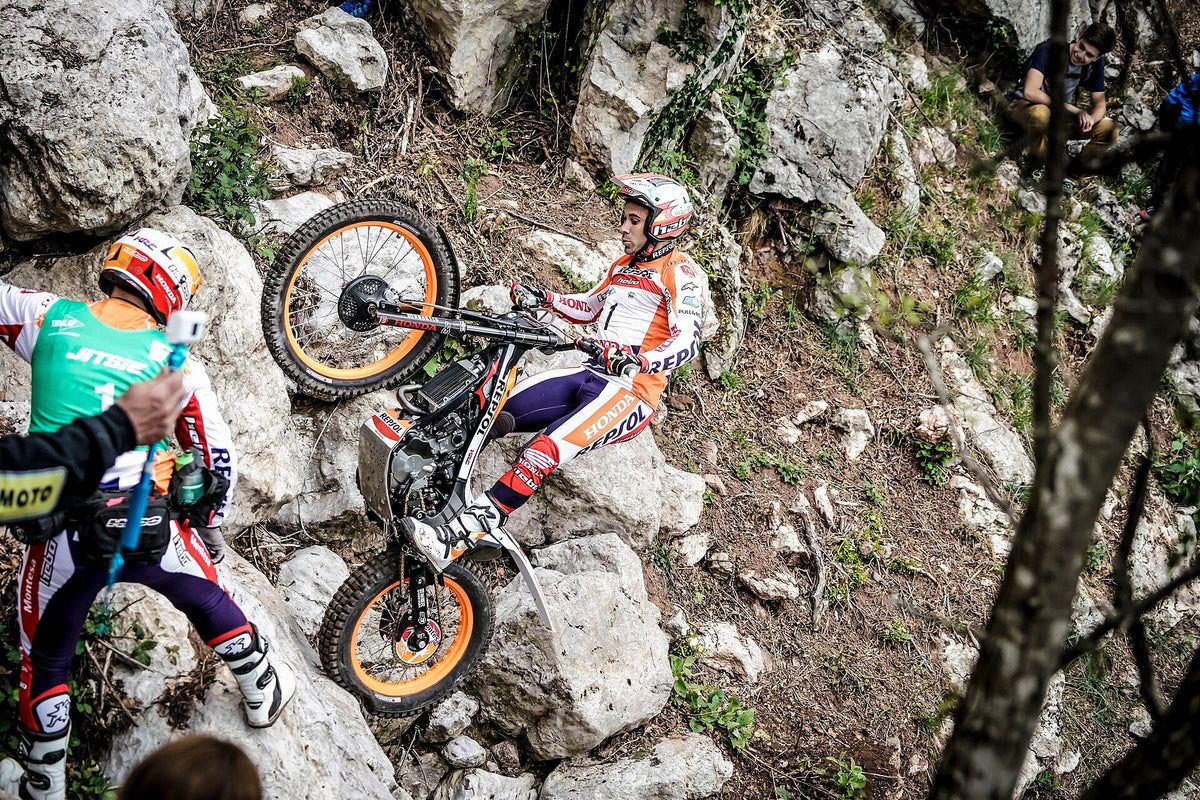
No trials bike has a competition record to match. In September 2026 Bou clinched his twentieth consecutive TrialGP world title at Zelhem in the Netherlands, with a round to spare. Add his twenty indoor X-Trial titles and he has forty world championships, every one of them won on a Repsol Honda Montesa. The factory bike Bou rides is not the bike in your dealer's window, but the 301RR shares its engine concept and much of its thinking.
What's new for 2027? Sources disagree
This is the part to read carefully if you are choosing between a 2027 bike and a discounted 2026.
- Honda's own European press release lists a "completely new" red and white livery as the only change on the 301RR. It then lists machined triple clamps, the aluminium frame and silencer, lobed high-performance brake discs and carbon protectors as features the bike keeps. For the 260R, the only change is a red and black livery.
- Spanish and Italian launch coverage (Todocircuito, Motopress and others) agrees: new liveries, technical specification confirmed.
- One UK Honda dealer's 2027 announcement lists the machined clamps, uprated discs and carbon protectors in a way that reads as if they are new for 2027. On the evidence of Honda's release, they are carry-over parts. The machined hubs and wave discs date back to 2022.
- Honda UK's own 301RR page says the 2027 bike has a "renewed design" and a rear shock with a new setting. No other source mentions a new shock setting.
Our reading: the 2027 Cotas are mechanically the same as the 2026 bikes, with new paint and possibly revised rear shock settings on the 301RR. If a dealer is selling a 2026 bike at a discount, it is essentially the same machine.
Specification
Figures are from Honda UK's 2027 specification pages unless stated. Honda's UK and US pages give different weights and, on the 260R, different suspension and ground clearance figures. We show both where they clash.
| Spec | Cota 4RT 301RR (2027) | Cota 4RT 260R (2027) |
|---|---|---|
| Engine | Single, four-stroke, SOHC, 4 valves, liquid-cooled | Single, four-stroke, SOHC, 4 valves, liquid-cooled |
| Capacity | 298 cc | 258.9 cc |
| Bore x stroke | 81.5 x 57.2 mm | 78.0 x 54.2 mm |
| Compression ratio | 10.4:1 | 10.5:1 |
| Fuel system | Honda PGM-FI injection, 28 mm throttle bore, two-map switch | Honda PGM-FI injection |
| Starting | Kick only | Kick only |
| Gearbox and clutch | 5-speed; wet multiplate clutch, hydraulic | 5-speed; wet multiplate clutch |
| Oil | 0.6 L engine, 0.57 L gearbox (separate) | Not listed on Honda UK |
| Frame | Aluminium twin spar | Aluminium twin spar |
| Front suspension | Showa 39 mm fork, 158 mm travel, preload, compression and rebound adjustable | Showa 39 mm fork, 158 mm travel, fully adjustable |
| Rear suspension | Pro-Link, Showa shock, 170 mm travel | Pro-Link, 170 mm travel; Honda UK lists both an R16V and a Showa shock on different pages |
| Brakes | 185 mm front disc, 4-piston caliper; 150 mm rear, 2-piston | 185 mm front disc, 4-piston caliper; 150 mm rear, 2-piston |
| Tyres | Michelin 2.75-21 / 4.00 R18 | Dunlop 80/100-21 / 120/100 R18 |
| Wheelbase | 1,320 mm | 1,320 mm |
| Seat height | 677 mm | 650 mm |
| Ground clearance | 310 mm | 335 mm on the spec page; 310 mm on the overview page |
| Fuel tank | About 1.9 L (Honda US: half a gallon) | 1.8 L |
| Weight | 73 kg kerb (Honda UK); 78 kg curb with full tank (Honda US) | Not published in the UK; 76.7 kg curb (Honda US) |
| UK price | £8,799 on the road | £6,999 on the road (2026 model £6,899) |
The engine: why a four-stroke works in trials
A trials engine needs to pull cleanly from almost nothing, not stall when you dab the clutch, and find grip on surfaces that would make you walk. The 4RT's single-cylinder four-stroke does that in a different way from a two-stroke.
A two-stroke fires every revolution and spins up very quickly. That makes it easy to pop the front wheel up a step, but it can also spin the rear tyre on wet rock. The Montesa's four-stroke fires every other revolution and has more inertia in its crank. The power arrives in fatter, slower pulses that let the tyre bite. On greasy Welsh slate and slimy winter roots, that means grip. It is also very hard to stall: owners have long praised the 4RT for starting first kick and plodding on at tickover.
The flip side is engine braking. Close the throttle on a four-stroke and the engine slows the bike more than a two-stroke would, which can lock or skip the rear wheel on a steep descent. Montesa has spent years taming this. The 301RR uses a gas decompression system, a crankcase breather enlarged in 2022, and an ignition map tuned to reduce it. Testers of the 301RR noticed the difference: TrialWorld found the engine "very elastic and punchy" with much less engine braking than before.
The 301RR's handlebar switch selects between two maps. Owners on Trials Central describe Map 1 as the stronger setting and Map 2 as softer, with less fuel and less ignition advance. Some riders struggle to feel the difference on a real section. Honda does not publish exactly how the maps differ.
The fuel injection is Honda's PGM-FI. It means no choke, no premix and no carburettor jetting to change as you climb from a valley floor to a Pennine moor. One quirk: the 4RT runs a fast idle, around 1,800 to 1,900 rpm according to owners, to keep the injection happy. Trials & Motocross News found that clubmen will need to slip the clutch in tight turns to control speed, and suggested a smaller 9-tooth gearbox sprocket and a steady right hand.
260R or 301RR?
The two engines suit different riders. When Trials & Motocross News rode the earlier 260 and 300RR side by side, it described the 260 as smooth, easy to control and user-friendly, but short of composure on bigger obstacles. The 300RR was "a lot of bike", a wheelie machine best for riders at the top of their game. TrialWorld's 2020 301RR test made the same point the other way round: less experienced riders may be more comfortable on the 260. The evidence from testers is that the 260R is the better bike for novices, lower club classes and returning riders.
Chassis, suspension and weight
Both Cotas share the aluminium twin-spar frame, 1,320 mm wheelbase and 39 mm Showa fork. The 301RR has a Showa shock on a Pro-Link rocker and adjustable preload, compression and rebound at the front. Testers since 2022 have described the full Showa set-up as more refined than the earlier Tech-equipped bikes, with a slightly firmer, planted feel.
The 260R's rear shock is a puzzle. Honda UK's 2027 specification page lists an R16V shock. The same site's overview page says Showa front and rear, and Montesa's 2022 launch material said the 260R had moved to full Showa suspension. If the rear unit matters to you, look at the shock on the bike in front of you.
Weight is the 4RT's weak spot. Honda UK quotes 73 kg kerb for the 301RR. Honda US quotes 78 kg curb including a full tank, and 76.7 kg for the 260R. TrialWorld's 2020 test called the 73 kg figure a dry weight and noted the bike still had not dipped below 70 kg. The truth is probably that 73 kg is close to dry and the US figure is ready to ride. Either way, the main two-stroke rivals claim 66 to 70 kg dry. You feel that difference when you pick the bike up, haul it round a tight turn or hop the back wheel.
Seat heights are 677 mm for the 301RR and 650 mm for the 260R, both lower than the Sherco ST's 704 mm. The 301RR's 310 mm ground clearance is in line with the class. The small tank, under 2 litres, is normal for trials, but owners on longer events have run dry, so carry fuel or check access to the fuel stop on a long Scott-style course.
Brakes are a 185 mm front disc with a four-piston caliper and a 150 mm rear, with lobed discs and machined hubs on the 301RR. The 301RR wears Michelin tyres and the 260R Dunlops; most riders swap to a favourite at the first change. See trials tyres.
Servicing and running costs vs a two-stroke
A trials two-stroke burns its oil with the fuel. You mix premix into every can of petrol, change the gearbox oil, and every so often rebuild the top end with a new piston and rings. There are no valves, no oil filter and no engine oil to change.
The Montesa runs separate engine and gearbox oils: 0.6 litres for the engine and 0.57 litres for the gearbox on the 301RR. There is a paper oil filter behind the flywheel cover, valves to check, and a throttle body to keep clean. Owners on Trials Central reported in 2019 that the manual calls for an engine oil change every 15 hours or six trials. Some change the filter every time, others every second change. One owner changes gearbox oil every 30 hours. Another pointed out that draining only removes about three-quarters of the engine oil, which is a good argument for not stretching the interval. Owners also recommend cleaning the throttle body, including its idle passage, once a year.
Valves. Most owners report that valve clearances hardly ever need adjusting. One rider found an exhaust valve had closed up from 0.30 mm to 0.18 mm after about 200 hours, which caused hard starting when hot. Resetting it cured the problem. That is the main symptom to watch for.
Top end. This is the four-stroke's strength. One owner who stripped an engine at about 500 hours of trials use found the piston only just past its service limit. Others report 700 to 800 hours without trouble. Owners point out that the 4RT is lightly stressed compared with the motocross engines it is related to, so the 15-hour piston changes of a race four-stroke are irrelevant here. Montesa's own 2015 manual is more cautious, suggesting a yearly piston inspection, so follow the book if you compete hard.
What does it cost? Honda UK does not publish a fixed service price, and dealer labour rates vary. Back in 2005 a rumour went round Trials Central that a 4RT cost £1,000 a year to service. Other owners dismissed it then, and nothing we have read since supports it. In practice a clubman doing his own oil and filter changes spends more often on small items than a two-stroke owner, and much less often on a top-end rebuild. When a four-stroke engine does need opening up, the job and parts cost more. Long engine life tips the balance back towards the Montesa.
Useful categories: oils, air filters, engine parts and fuel system parts.
Reliability reputation
The 4RT's reputation is the main reason people buy one. Owner threads going back to 2005 describe superb build quality, bolts that go back in without a fight, and bikes that start first kick every morning of a six-day event. Trials Central regulars note that Montesa owners tend to keep their bikes longer than two-stroke owners, and that the 4RTs entered in club trials are older on average than the two-strokes.
It is not perfect. Over the years owners have reported:
- Fuel and electrics. Starting and running faults traced to corroded condenser wiring, a poor earth, a fuel pump connector, a faulty fuel pump or a worn throttle body. On one 2009 bike, corrosion in the metal sump under the fuel pump blocked the filter. A side stand rubbing through the wiring loom has also been reported.
- The bank angle sensor. A safety switch that cuts the engine if the bike falls over. Some owners bypass it. If you do, link the correct connectors, because simply unplugging it stops the bike starting.
- Clutch feel. Early owners felt the standard clutch master cylinder lacked feel. TrialWorld also found the 301RR's clutch heavier than the 260's.
- Side stand. A long-running moan. One owner welds his once a year.
- Frame cracks near the footrest hangers. Reported, but described by experienced owners as very rare and usually linked to aftermarket hangers.
Our reading of the forum history is that the engine is close to bulletproof, and most faults are electrical niggles on older bikes that are fixable at home with patience and a multimeter.
Buying a used 4RT
A used Montesa is a common route into four-stroke trials, and used 4RTs hold their value well because buyers trust the engine. UK sale results are scattered across dealers, auctions and private ads, so we do not quote a price guide. Instead, here is how to tell the generations apart and what to check.
The generations
- 2005 to 2013: 4RT 250 (249 cc). The original. Capacitor-powered injection, tall first gear by owner accounts. An early forum owner of three of these called them heavy and slow-turning in tight going. The cheapest way in, and the most likely to have the electrical faults above.
- Race Replica and Repsol editions. Offered across several generations until the 301RR Race Replica was dropped for 2026. Higher-spec versions in Bou's colours. Trials & Motocross News found the Repsol's Showa suspension firmer and its engine sharper than the standard 260.
- 2014 to 2021: 4RT 260. The bigger 260 cc engine, with a fuel pump and mapping update for 2016. Tech fork and R16V shock on the standard bike.
- 2016 to 2019: 300RR (288 cc). The first "Race Ready" model, strong and lively. Tech fork.
- 2020 onwards: 301RR (298 cc). More power, less engine braking. Showa fork from 2022, plus the larger breather and wave discs. A 2022-on 301RR is the one to look for if you want the current bike without the new price.
- 2022 onwards: 260R. Showa suspension and the 301RR's aluminium silencer. The best used buy for a clubman.
What to check
- Cold start. Ask for the bike to be cold. It should start in a kick or two and settle at a fast idle around 1,800 to 1,900 rpm.
- Hot start. Ride it, stop, and restart it hot. Hard hot starting can mean tight exhaust valves.
- Service history. Oil and filter changes matter more on a four-stroke than on a two-stroke. Look for receipts or a logbook.
- Wiring and connectors. Look behind the engine for a chafed loom near the side stand, and for green corrosion on connectors under the tank.
- Bearings. One owner rebuilding a 2006 bike found every bearing except the swingarm's was scrap. Check the headstock, wheel bearings and linkage for play.
- Frame and hangers. Inspect around the footrest hangers and underneath for cracks or deep gouges.
- Paperwork. Check the V5C if it is road registered, and whether the frame number matches.
Browse Montesa 4RT bikes for sale and Montesa 4RT, 300RR and 301RR parts. If you are looking at the trail version, see 4Ride bikes for sale.
Montesa 4RT vs the alternatives
Rival prices are UK dealer or importer list prices at the time of writing (November 2026). Weights are each maker's or dealer's claimed figure and are measured differently, so small gaps are not reliable.
| Spec | Montesa 301RR | Beta Sincro 300 | Sherco 300 ST Factory | Beta Evo 300 4T | TRRS One RR |
|---|---|---|---|---|---|
| Engine | 298 cc four-stroke | Two-stroke | Two-stroke | 297 cc four-stroke | Two-stroke |
| Fuel system | Injection | Keihin carburettor | Injection | Mikuni carburettor | Carburettor or injection |
| Claimed weight | 73 kg kerb | About 66 kg dry | About 70 kg dry | Not published in the UK | 66 kg dry |
| Electric start | No | Yes, as an option | ST-E model | No | Optional |
| Seat height | 677 mm | 670 mm | 704 mm | Not confirmed | Not confirmed |
| UK price | £8,799 OTR | £6,995; £7,495 e-start | £7,999; £8,299 ST-E | £6,695 (dealer, run-out) | About £6,849 to £7,995 |
Beta Sincro 300 (£6,995 to £7,495)
The new default two-stroke. The Sincro replaced the long-running Evo with a new engine and reworked chassis, and for 2027 the 300 gets a new cylinder head and silencer, with electric start available. It is several kilos lighter and £1,300 to £1,800 cheaper than the 301RR, with the biggest trials dealer network in the UK. Early owners have reported a sudden "snatchy" clutch take-up, so ride one first. The 300 SS is the softer-delivery version and the most direct two-stroke answer to the 4RT's smoothness. Choose the Sincro if you want lightness and electric start; choose the Montesa if you want grip, stall resistance and a proven engine. See Beta Sincro parts and Sincros for sale.
Sherco 300 ST Factory (£7,999 to £8,299)
The sharp, injected expert's tool. For 2027 the 300 gets a redesigned cylinder and new mapping for smoother power, and the electric-start ST-E drops its kickstart and gets a lighter BOS shock. It is lighter and livelier than the 301RR and the e-start option is a real advantage after a fall in a stream. It is also taller and likes more revs, which can catch out a nervous rider. For an expert comparing injection with injection, it is the closest rival on price. See Sherco ST parts.
Beta Evo 300 4T (about £6,695)
The only other four-stroke trials bike on sale in the UK. It is smooth, tractor-like and cheaper than the 301RR, with Ollé suspension updated for 2026. It runs a Mikuni carburettor rather than injection, and Beta has not yet announced a Sincro four-stroke, so this is a bike near the end of its run. One UK dealer was advertising its "last batch" in 2026. It suits a clubman who wants four-stroke manners for less money and does not mind buying the last of a line. For a 260R-level rider, the Montesa costs only about £300 more and comes with Honda's dealer network. See Beta Evo parts.
TRRS One RR (about £6,849 to £7,995)
The value pick, and now available with injection as well as a carburettor, and with optional electric start. TRS claims 66 kg dry. Owners who have switched describe a light front end that hops easily and a revvy, more highly strung engine. That is close to the opposite of the Montesa's character. The cheaper One R starts at £6,399. See TRRS One parts.
Who the 4RT suits: the scale
Here is how the two Montesas compare with the Beta Sincro 300 for different riders. The further right the dot, the better the fit. These are our judgements from the specifications, tests and owner feedback, not a timed test.
Who should buy a Montesa Cota 4RT?
- Clubmen who ride slippery British venues. Wet rock, roots and mud are where the four-stroke's delivery earns its keep.
- Riders who want one bike for ten years. The engine's long life and strong resale make the high price easier to justify.
- Returning riders and novices: the 260R, not the 301RR. It is smoother, cheaper and lower.
- Ambitious Clubman A and Expert riders who prefer a four-stroke: the 301RR.
- Riders who stall a lot. The 4RT's fast idle and torque make it famously hard to stall.
Look elsewhere if you are light, want electric start, or ride an aggressive hop-and-splatter style.
The Trials Bike Classifieds verdict
The Cota 4RT remains the benchmark four-stroke trials bike, and with the Beta Evo 4T near the end of its run, it may soon be the only one. The 301RR is the more capable bike: strong, refined since its 2022 Showa update, and backed by the most successful competition record in the sport. At £8,799 it is the most expensive bike in its class and its extra weight is real. The 260R at £6,999 is the better buy for most UK clubmen. It has the same frame, fork and engineering, a smoother engine and a lower seat, for about the price of a Beta Sincro 300. The 2027 update is cosmetic on the evidence of Honda's own release, so a discounted 2026 bike or a 2022-on used example is good value. Buy a 4RT for grip, reliability and resale. Buy a two-stroke if lightness and electric start matter more.
Availability in the UK
Montesa is sold through Honda UK's off-road dealer network, so parts and servicing support is wide. Some Honda dealers still add a preparation fee: one lists £99 for a combustion-engined bike. Ask whether the price includes a V5C, pre-delivery inspection and the first service, and which model year you are getting. With Honda UK still listing the 2026 260R at £6,899 alongside the 2027 model at £6,999, there may be run-out bikes on dealer floors.
For used bikes, see Montesa 4RT for sale, all trials bikes for sale, and the wider modern trials range. If you are after the last two-stroke Montesa, see Cota 315R parts.
Related reading
The first parts to fit
- Fresh oil and a filter. On a used bike, start with known oil in both the engine and gearbox. See oils and air filters.
- A sump guard. Owners who ride big rock fit an aftermarket guard over the standard aluminium plate. See sump guards.
- Gearing. A smaller gearbox sprocket helps tame the fast idle in tight sections. See chain and sprockets.
- Clutch parts. If the clutch feels wooden, look at the master cylinder and lever. See clutch and levers.
- Tyres. A fresh rear trials tyre is the cheapest grip you can buy. See tyres.
- Electrics spares. On older bikes, a spare plug cap and clean connectors save a day out. See ignition and electrics.
- A stand. Given the side stand's reputation, a paddock stand is worth having. See stands.
Frequently asked questions
How much is a Montesa Cota 301RR in the UK?
At the time of writing, Honda UK lists the 2027 Cota 4RT 301RR at £8,799 on the road and the 2027 260R at £6,999 on the road. The 2026 260R is listed at £6,899, so run-out bikes may be available.
What is new on the 2027 Montesa Cota?
Honda's own press release lists new liveries only: red and white for the 301RR, red and black for the 260R. Honda UK also mentions a new rear shock setting on the 301RR. Some dealer material presents the machined clamps and lobed discs as new, but they are carry-over parts.
What is the difference between the Montesa 260R and 301RR?
The 301RR has a 298 cc engine with a two-map switch, Showa suspension front and rear and a 677 mm seat. The 260R has a smoother 259 cc engine, the same frame and Showa fork, a 650 mm seat and costs £1,800 less. Testers suggest the 260R suits novices and most clubmen better.
How many world titles has Toni Bou won on a Montesa?
In September 2026 Toni Bou won his 20th consecutive TrialGP outdoor title, which with 20 X-Trial indoor titles makes 40 world championships, all with Repsol Honda Montesa since 2007.
How often does a Montesa 4RT need servicing?
Owners report the manual calls for an engine oil change every 15 hours or six trials, with the filter changed every one or two oil changes and gearbox oil around every 30 hours. Valve clearances rarely need adjusting, and pistons have lasted around 500 hours of trials use.
Is the Montesa 4RT reliable?
The engine has an excellent reputation for long life and easy starting. Most reported faults on older bikes are electrical, such as corroded connectors, fuel pump wiring and the bank angle sensor, and are usually fixable at home.
Does the Montesa Cota 4RT have electric start?
No. Both the 2027 301RR and 260R are kickstart only, whereas the Beta Sincro, Sherco ST-E and TRRS One RR offer electric start.
Is a four-stroke trials bike good for beginners?
A four-stroke like the Montesa 260R is smooth, grippy and hard to stall, which helps novices. It is heavier than a two-stroke, so lighter riders may find a two-stroke easier to move around.
More reviews & comparisons
- Trials Bike Maintenance Guide: After-Trial Routine, Service Intervals and Winter Storage for UK ClubmenA practical maintenance routine for UK trials riders: how to wash without wrecking bearings, what to check before eve...
- Two-Stroke vs Four-Stroke Trials Bike: Montesa 4RT vs Beta Sincro, Sherco and TRRS for UK RidersWith Beta's Evo 4T on its last batch, Montesa is almost the only four-stroke left. We compare two-stroke and four-str...
- How to Start Trials Riding in the UK: Clubs, Licences, Kit, Costs and Your First Bike (2026/27)The complete beginner's route into observed trials in Britain: how scoring works, finding an ACU or AMCA club, 2026 l...
- Best youth petrol trials bike 2027: Beta Evo 80 Junior vs Senior, TRRS 80 and the step to 125Moving your child up from an electric bike? We compare every new and used petrol youth trials bike for UK riders, fro...